Monthly Archives: February 2026

February 1, 2026

By David Snowball

Welcome to the February issue of Mutual Fund Observer.

We’re glad you’re here.

I’ve always been fascinated by the interplay of climate and culture, the way that our physical world seeps deep into our cultural bones. After years of The News from Lake Wobegon, Minnesota, gained an almost mythical spot in my vision of people in winter. For those of you who haven’t visited, the temps in Minneapolis hit -21 degrees Fahrenheit in January, and the force of the wind deducted another 30 degrees from that total. That’s low enough that your teeth ache and nose hairs freeze when you breathe in, about cold enough for them to declare their children can’t go out in shorts. There’s a sort of amiable stoicism about the challenge; Garrison Keillor’s story “The Stone” celebrates the habit of carrying a 25-pound rock with you when you go to visit friends on a winter’s night. You arrive out of breath and covered by a sheen of sweat and allow, “It was heavy, but it did its job… It kept me warm.” And the great upside of “a sub-zero winter? Well, at least it keeps the riff-raff out.”

These are the children of Scandinavia, inheritors of cultural lore that includes the Norse raiders we call Vikings and cultural traditions shaped by intense winters that made selfless cooperation into a survival value. Most Norse people were small farmers, but a minority of men periodically went viking; their raiding grew out of a farming-based society under resource pressure and was driven by profit, prestige, and need. Their reckless bravery was legendary. The Scandinavian heritage includes a deep commitment to community, captured in the Swedish concept of lagom (just right, balanced), Norwegian dugnad (communal work for the common good), and Danish hygge (coziness and community).

Both of those strands have been in evidence this year.

Image generated using ChatGPT

On numbingly cold days, day after day, Minnesotans stood up and stepped outside. They didn’t step outside to complain about the cold or petition the federal government for relief. They stepped outside because their neighbors — some born in Minneapolis, others in Mogadishu — needed someone to walk their children to the bus stop. Because immigrant families hiding from federal agents needed groceries. Because when masked officers with military weapons appear in your neighborhood, someone needs to be there with a camera and a whistle, documenting what happens next.

The children of the Norse, it turns out, inherited more than a tolerance for absurd cold. They inherited something about community, about collective welfare, about the quiet strength that doesn’t require bellicose chest-pounding or thuggish displays of power. The same cultural DNA that produced “Minnesota Nice,” that sometimes-mocked politeness and self-effacement, also produces a steel spine when circumstances demand it.

They’ve been noticed. Literally hundreds of folks in Davenport, not a hotbed of liberal activism, gathered on the streets with signs of solidarity. Protesters in Boston were recorded chanting, “We’re not cold, we’re not afraid, Minnesota taught us to be brave.” When the Minnesota National Guard was deployed in response to requests from the mayor and sheriff, those armed troops arrived bearing coffee and donuts and hand warmers for their brothers and sisters.

I’ve read my share of reveries on the passing of the Greatest Generation, most of them lamenting that Americans today are soft and self-absorbed, too whiny to summon the resolve their grandparents used to endure a Great Depression and still face down Hitler, then build a prosperous nation. I once suspected it myself. Now, I am not so sure.

Minnesota taught me better.

In this month’s Observer

The One Uncorrelated Portfolio to Rule Them All by Slaying Inflation and Market Corrections, by our colleague Charles Lynn Bolin, tackles the challenge of building a portfolio that can weather both inflation and market corrections by searching through hundreds of alternative funds for options that zig when others zag. His “Grins and Giggles Portfolio” minimizes correlation between holdings over the past six years, while his “Last Laugh Portfolio” achieves 8.3% annualized returns with a maximum drawdown of just -6.3% over ten years. The secret? Four alternative funds that move independently of each other and traditional asset classes. Lynn’s analysis is grounded in consensus expectations for slow economic growth (2.2% GDP in 2026, falling to 1.8% by 2028) and elevated valuations that make diversification more critical than usual. He also sounds the alarm about financial innovations, from leveraged ETFs to options-based products, that pose risks even to investors who don’t own them, through the potential for financial contagion.

Perpetual Motion Income Machine, by Charles Lynn Bolin. Can you build an income portfolio that generates steady distributions while beating inflation? Lynn believes you can, targeting 7% minimum returns to cover 4% withdrawals plus 3% capital appreciation. He divides nearly 100 income funds into four groups based on capital appreciation and yield, identifying funds with high risk-adjusted yields and consistent distributions. The key insight: balance funds that fluctuate with interest rate cycles against those tied to stock market cycles to reduce sequence-of-return risk. Lynn’s research covers everything from loan participation funds to alternative credit vehicles, with particular attention to funds that maintained steady income through both the 2020 COVID crash and the 2022 rate-rising period. His approach emphasizes risk-adjusted yields rather than simply chasing the highest distributions, acknowledging that real inflation has averaged 2.3% since the 1980s and that three major secular bear markets over the past century have destroyed purchasing power for most portfolios.

Quality Worked in 2025, and failed spectacularly, looks at what “quality” investors did, and didn’t accomplish in 2025, and how to think about them in the years ahead.

A Letter to Layla is directed to the young trainer who is trying to coax Chip and me into being fit; we meet Layla at the YMCA gym twice a week, do our best to avoid embarrassing ourselves in public – I do a mean set of dead bugs – and try to stick with the program. Layla has been exceptionally thoughtful in structuring our efforts and, just recently, admitted that she would like to learn a bit about mutual fund investment so she can start moving in a healthy financial direction. This is my attempt to think about investing strategies for folks of Layla’s age – or my son Will’s – from the perspective of her work as a trainer.

The Indolent Portfolio, 2025, is the latest installation in my annual portfolio disclosure. It offers suggestions for how to build a low-maintenance portfolio and a three-fund alternative to my admittedly sprawling collections. (PS, the portfolio itself did just fine last year: stable, cash-rich, and up 14%.)

Our colleague The Shadow shares a wealth of industry news and foolishness, as ever, in Briefly Noted.

On the passing of Doug Ramsey

Doug and Diane

The folks at the Leuthold Group shared sorrowful news last week. I’ll let them speak for themselves:

It is with profound sadness that we share the news that our longtime friend, colleague, and partner, Doug Ramsey, passed away on January 22. This year, we celebrated Doug’s 20th anniversary with The Leuthold Group, though our relationship with him extended back to the 1990s, when he was first a research client. Doug’s encyclopedic memory and deep grasp of market history made him an ideal fit for our firm. In 2011, he became our Chief Investment Officer, leading our investment team and serving as a major contributor to our monthly research publication, Perception for the Professional. Doug will be deeply missed by all who had the good fortune to know and work with him.

Doug was an Iowa native, went to school in Cedar Rapids before heading to The Ohio State University to earn a master’s in economics. As a professional, he was equally famous for his extraordinary memory, his ability to make numbers speak, and the rarer ability to give the rest of us some clue about what they said. He and his beloved Diane met in Iowa City, were married in 1994, raised children and golden retrievers with equal aplomb, did Minnesota stuff – some substantial fraction involving rods, reels, rivers, lakes, and forays in the dead of winter to the only open water available (just downstream of the nuke) by way of recreation. Doug had been suffering some unrelated (?) pains in recent months, and the other Leuthold folks stepped in to make sure that there was no stumble. He was felled by a brain aneurysm at age 59.

It’s easy to think of investment advisers, even boutiques like Leuthold, as faceless automata. It’s an illusion that crumbles when you’ve had the chance to chat for hours over the phone or to sit with folks in their breakroom, sipping coffee (if you visit Minnesota, you’re actually legally required to develop a taste for black coffee and quiet conversation) and nibbling pastry. There you discover that Doug was funny and understated, reflective about his industry, his beloved city, his clients (aka “you”), and the colleagues with whom he’d shared decades. Paula Mikl, one of those colleagues, lost her dad last fall, which she could sort of manage. But “Doug’s passing seemed to cut even deeper; there were no signs, just sudden finality. We are a small, close-knit group; we are hurting at the loss of our friend and partner, but finding a way to move forward.”

Infrastructure: The Trillion-Dollar Distraction You’re Ignoring

While ChatGPT was writing your emails, geologists confirmed Manhattan is sinking under the weight of its own skyscrapers, requiring billions in flood barriers and foundation reinforcements. Miami is sinking faster and faces the bill first.  43,000 American bridges continued their slow collapse. (They’ve been recognized as “the most dilapidated on Earth” so … uhh, we’re number one!).  Our western snow drought just hit record levels, threatening water supplies, and the electric grid needs $2 trillion in upgrades before your AI dreams can plug in. Uncomfortable reminder: the physical world still exists, requires continuous investment, and won’t maintain itself while we chase the next magnificent stock. Infrastructure funds gained 20.5% in 2025, crushing tech-heavy benchmarks, but who noticed?

BNY Mellon Global Infrastructure Income ETF led the category, up 37.8%, beating peers by 17.4 points. Their media team promised insights has sort of ghosted us … so we’ll profile them anyway in March alongside Brookfield Next Generation Infrastructure, iShares Emerging Markets Infrastructure, and Lazard Global Listed Infrastructure (a Great Owl fund). Consider this your heads-up: trillions must flow into roads, bridges, water systems, and power grids in the years ahead, regardless of what happens with artificial intelligence. Trillions must flow into roads, bridges, water systems, and power grids in the years ahead, regardless of what happens with artificial intelligence.

Thanks, as ever …

To The Faithful Few whose monthly support keeps the lights on and supports up: Gregory, William, William, Stephen, Brian, David, Doug, Altaf, Wilson and the good folks at S & F Investment Advisors.

And to a host of others who’ve offered support in the past couple of months. Because Chip and I were on the road over New Year’s, we weren’t able to properly recognize the generosity of Rae from Cincinnati, Mark from Swartz Creek, Marc from Maryland, Charles from Indianapolis, Binod from Houston, the Ellie and Dan fund, Kevin from Brooklyn, Joseph from Centennial, Sunny from Westlake Village … and an anonymous bear-shaped bull! And, in January, we add many thanks to Wayne, our first donation through the PayPal Giving Fund, Kathleen from Redwood, Gary from Sacramento, and Sharon from Washington. We appreciate your support!

We reminded readers this month that your investment advisor doesn’t need you nearly as much as the world does. If you’re disposed to act upon that suggestion, consider contributing to a needy teacher (K-12) through Donors Choose. You choose the project and the amount, whether its $5 or $500. This month, I chose to help provide the final bit of support needed to complete a project in St. Paul, Minnesota, Minneapolis’s twin sister.

When I did, Donors Choose reminded me that they are making a special request to support the teachers and kids in the Twin Cities:

The Minnesota Students & Teachers Fund will provide urgent resources to Twin Cities-area educators tirelessly working to provide stability and safety in their community. Make your donation to the Minnesota Students & Teachers Fund, and we’ll direct your gift to meet the most pressing teacher needs in the Twin Cities. These resources will be distributed quickly to support classrooms where support is needed most.

And so, I did.  You might consider it if you’re not predisposed to trudge out in weather that even Minnesotans allow, “is a might nippy.”


david's signature

The One Uncorrelated Portfolio to Rule Them All by Slaying Inflation and Market Corrections

By Charles Lynn Bolin

Perhaps you may be amused by the similarities of this article, where I search through hundreds of alternative funds to slay the dragons of inflation and market corrections and the delusions of Don Quixote de la Mancha, who set out on misadventures for chivalry. I am not ready to denounce alternatives as foolish fiction, as Don Quixote denounced chivalry before dying.

Don Quixote and Sancho Panza going to the wedding Gamaches (1850) by Honore Daumier Source: Artchive

For this article, I created the Grins and Giggles Portfolio with the objective to minimize the correlation between the funds for the past six years. I follow this up with the Last Laugh Portfolio that achieves 8.3% APR with a maximum drawdown of -6.3 for the past ten years. I constrained this portfolio with four alternative funds. The value of the one-million-dollar Last Laugh Portfolio never drops below its original value, even with a four percent withdrawal rate; however, purchasing power temporarily dropped by 8% as a result of high inflation. Don Quixote and I have our windmills to fight.

2026 Investment Outlook

The consensus is for slow economic growth. CBO’s Current View of the Economy From 2026 to 2028, by the Congressional Budget Office, estimates that real gross domestic product (adjusted for inflation) will fall from 2.2% in 2026 to 1.8% in 2027 and 2028. Core inflation is estimated to fall gradually from 2.8% in 2026 to 2.2% by 2028. The Federal Funds rate is estimated to fall to 3.4% in 2026 and remain there through 2028, while the 10-Treasury hovers around 4.3%. Unemployment remains elevated at around 4.4%.

The World Bank just released Global Economic Prospects, which estimates that real GDP growth for the world will be 2.7% next year. They estimate that real GDP in the US will be 2.2% in 2026 and fall to 1.9% in 2027.

In Investor Lessons From 2025 For 2026, Lance Roberts from RIA Advisors describes elevated valuations for stocks and that “expectations for profit margins are near historic highs.” He points out that earnings are sensitive to economic growth:

Furthermore, given the overall sensitivity of earnings to economic growth, any slowdown in economic activity or employment in 2026 could become more problematic. With valuations and confidence elevated, investors should consider rebalancing portfolio risk to hedge against potential disappointment.

Financial Innovations

In the previously cited article, Lance Robert describes the risks of retail investors misusing financial innovations in the options market, only to lose most of their savings. In Retail Leverage Goes to Extremes, he states:

“Wall Street is happy to produce products to meet investor demand, with the speculative risk soaring it is not surprising to see more speculative products surge in quantity. However, with that demand, is also the risk. These products in particular use options, which work great as long as the market is rising. However, these products can, and will, go to “zero” during a market decline. Most retail investors piling into these securities do not fully comprehend the risk they are taking.”

The 1929 stock market crash was exacerbated by inexperienced investors buying stocks using the financial innovation of margin debt, which was encouraged by a few leaders in the financial industry. Today, there is again a high level of margin debt along with high national debt, and more financial innovations.

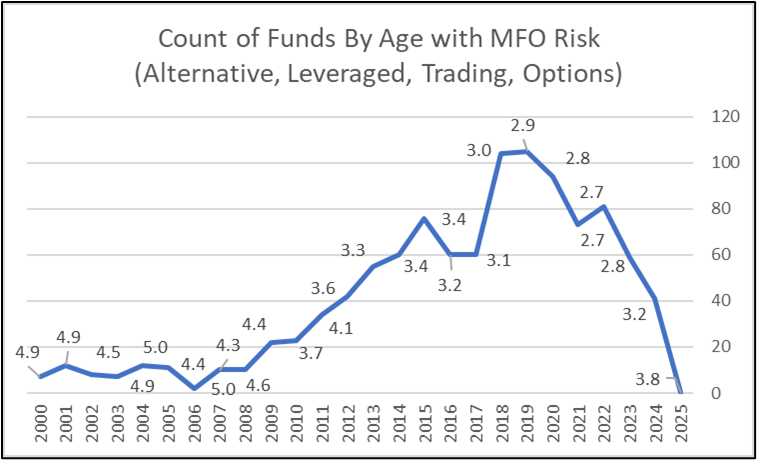
Many financial innovations are beneficial, like Traditional IRAs, Roth IRAs, mutual funds, exchange-traded funds, and online access. Other financial innovations are very risky for unsuspecting investors. There are approximately seventeen hundred funds classified as alternative, leveraged, trading, or using options. The average age of these funds is only seven years, implying there are a lot of untested funds on the market and/or high survivorship bias. Only fifty-one (3%) of these funds meet my loose criteria of a MFO Risk Rating of Very Conservative to Moderate, MFO Rating of “Average” or better for risk-adjusted performance, at least $100M in assets under management, ten years of performance history, expense ratio 2% or lower, and lifetime APR of 4% or more.  

Figure #1 shows the funds by age along with the average MFO composite Risk Rating. Recent funds are rated to be more conservative than older ones that survived the financial crisis. Don Quixote and I have had to ground our imagination in reality.

Figure #1: Alternative, Leveraged, and Trading Funds by Age

Source: Author Using MFO Premium fund screener and Lipper global dataset

My conclusion is that these funds, high national debt, deregulation, less independence of the Federal Reserve, and the rise of shadow currencies (crypto) increase financial risk. Even if you don’t own any of these financial innovations, they increase the risk of financial contagion.

The Grins and Giggle Portfolio

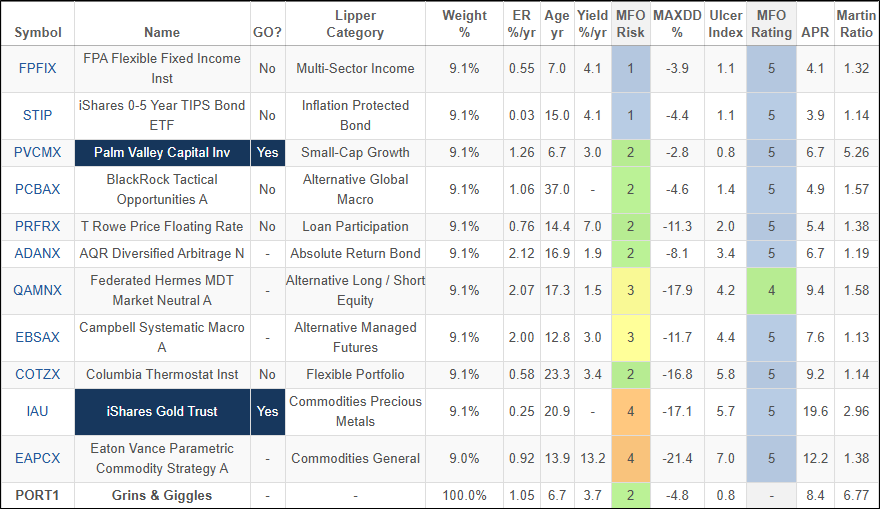
I came up with the idea to create a portfolio that minimizes the correlation between the funds with the objective of achieving at least 8% returns with a low drawdown. I didn’t know if I could create a large correlation matrix for one hundred funds that had the potential to be part of the portfolio, and so I took it on as a technical challenge for grins and giggles. This process seeks funds that zig when others zag. The funds are split fairly evenly among Alternative, Bond, Mixed Asset, and Equity categories, along with gold and one general commodity fund.

I used Excel Solver to minimize the correlation of the funds given constraints of a minimum annualized return of 8%, and drawdowns of less than -8% in both the COVID Bear Market (2020) and Great Normalization Bear Market (2022). Table #1 contains the Grins and Giggle Portfolio. Three of the funds (PVCMX, PCBAX, and IAU) are already in my Core TIRA portfolio. The funds are sorted by composite MFO Rating to reflect long-term risk.

Table #1: Grins and Giggles Portfolio – Six Years

Source: Author Using MFO Portfolios and Lipper Global Dataset

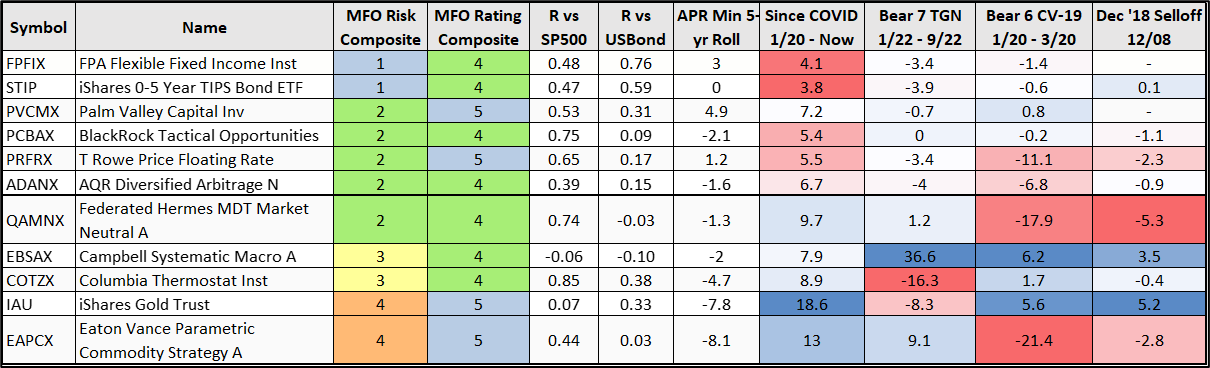
Table #2 shows how the funds performed in several different environments, along with the correlation to stocks and bonds. I am more concerned about a recession-induced bear market with high equity valuations than I am rising rates, because rates are already high.

Table #2: View of Grins and Giggles Portfolio During Unique Periods – Life of Fund

Source: Author Using MFO Premium fund screener and Lipper global dataset

Understanding Alternative and Riskier Income Funds

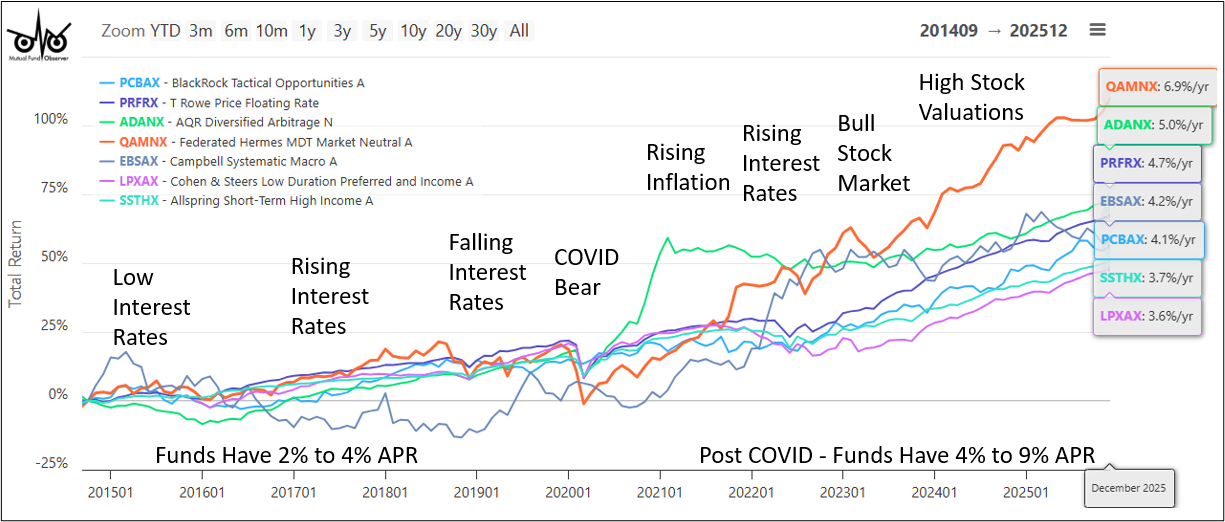
I look for alternative funds like BlackRock Tactical Opportunities (PCBAX) that increase somewhat steadily over time with high risk-adjusted returns. I own shares of PCBAX. I am becoming more comfortable with alternative funds like AQR Diversified Arbitrage (ADANX) with modest returns over time that act more as insurance during stressed markets.

Figure #2 shows how funds that produce income performed in many environments. Cohen & Steers Low Duration Preferred and Income (LPXAX) and Allspring Short-Term High Income (SSTHX) have the least volatile profiles, along with T Rowe Price Floating Rate (PRFRX), which does well when rates are rising. Alternative funds Federated Hermes MDT Market Neutral (QAMNX) and AQR Diversified Arbitrage (ADANX) have low correlation with each other.

Figure #2: Alternative and Riskier Income Fund Performance – 10 Years

Source: Author Using MFO Premium fund screener and Lipper global dataset

How much of the past ten years will rhyme with the next ten years? Domestic stocks are likely to underperform because of high starting valuations. Fixed income is likely to perform well over the next five years because of high starting yields, but high global debt levels pose new risks. There may be an effort to push rates lower to finance the national debt in order to reduce debt burdens. Geopolitical risk appears to be higher for the coming ten years. As described in Our Dollar, Your Problem (2025) by Kenneth Rogoff, we may experience “a sustained period of global financial volatility marked by higher average real interest rates and inflation and more frequent bouts of debt and financial crises.”

The Last Laugh Portfolio

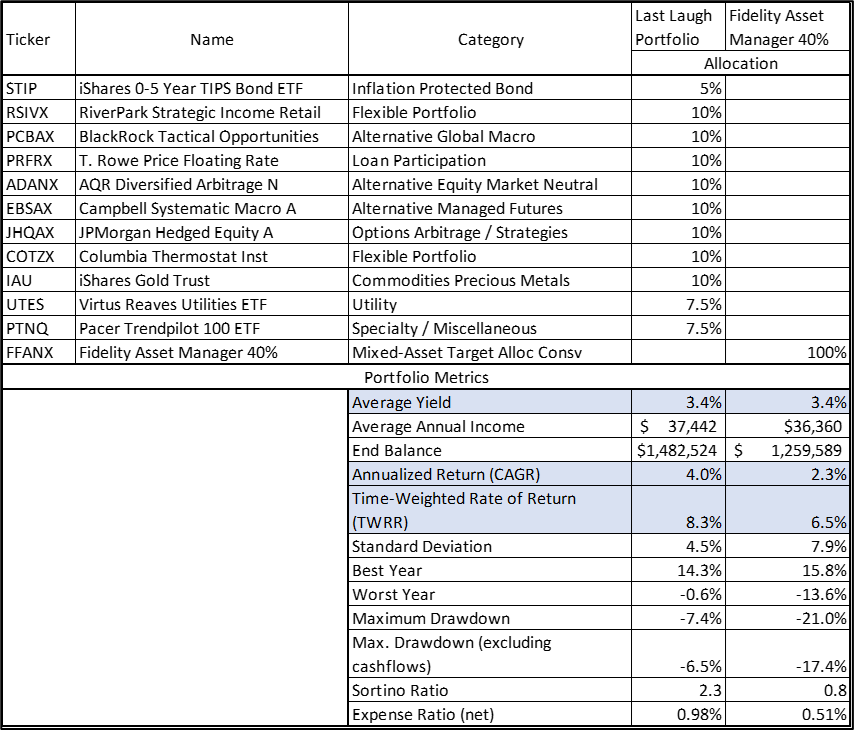
He who laughs last laughs best! I used Portfolio Visualizer to minimize the volatility for a target APR of 8% for the past ten years using the uncorrelated funds identified for this article. The link to Portfolio Visualizer is provided here. The assumptions are that there are quarterly withdrawals of 1%. The results are shown in Table #3.

Table #3: Last Laugh Portfolio Compared to Fidelity Asset Manager 40%

Source: Author Using Portfolio Visualizer

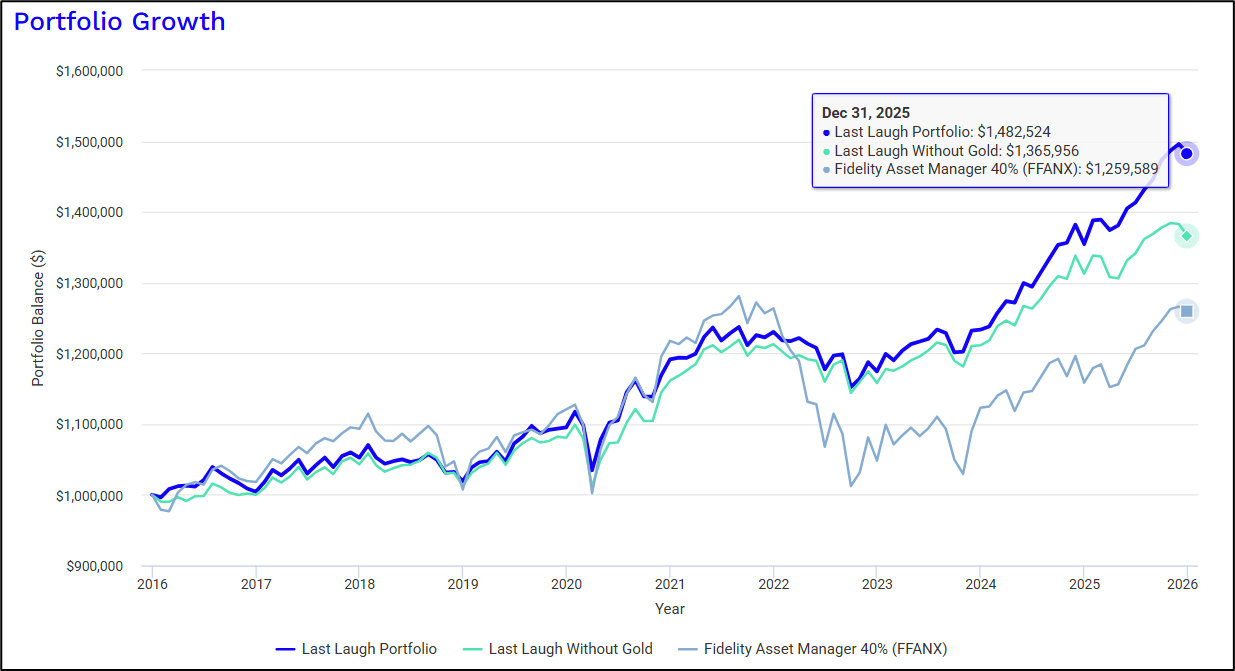
Figure #3 shows the results. Without the large contribution of iShares Gold Trust (IAU), the Last Laugh Portfolio would have returned 7.4% annualized instead of 8.3%.

Figure #3: Last Laugh Portfolios Growth of Investment with Fidelity Asset Manager 40%

Source: Author Using Portfolio Visualizer

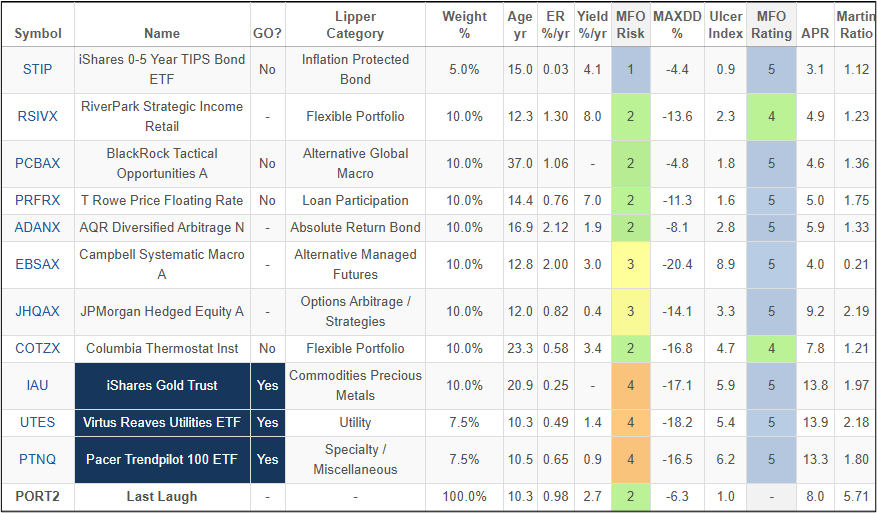
Table #4 contains the Last Laugh Portfolio for the past ten years. The funds are sorted by composite MFO Rating to reflect long-term risk.

Table #4: Last Laugh Portfolio

Source: Author Using MFO Portfolios and Lipper global dataset

Lessons Learned from the Sequence of Return Risk Light

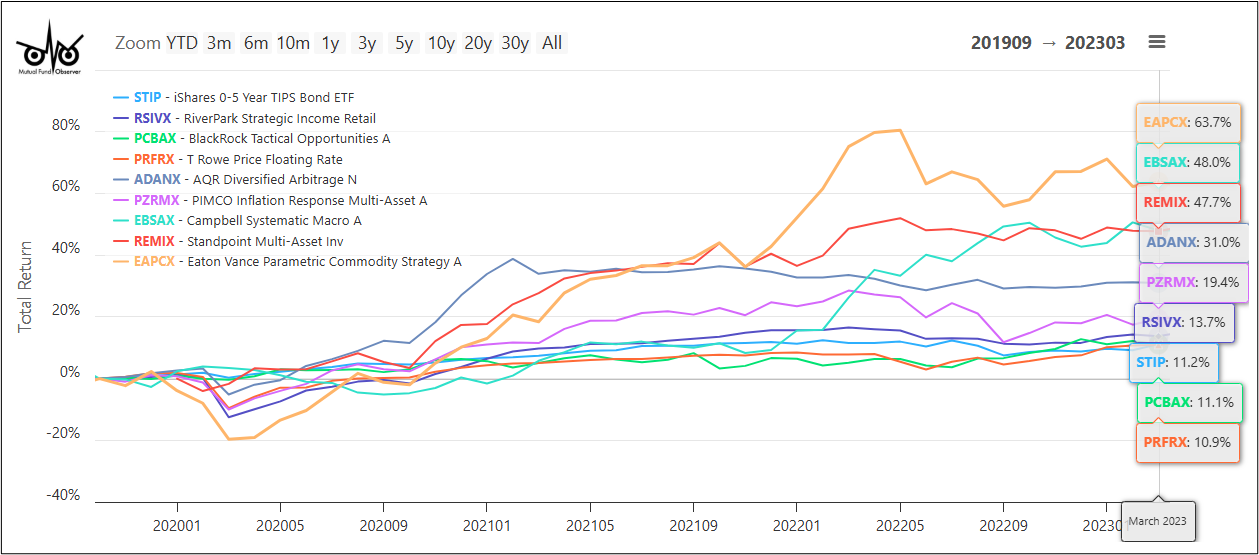
This article is about reducing the sequence of return risk using the relatively short period from the COVID bear market through the Great Normalization of rising rates with high inflation. It is a window into how funds might have performed in a more severe stagflation period like the 1970s. Figure #4 shows the best-performing funds from the Grins & Giggles and Last Laugh Portfolios, along with Eaton Vance Parametric Commodity Strategy (EAPCX) and PIMCO Inflation Response Multi-Asset (PZRMX). Commodity funds do well during inflation but poorly during recessions. PZRMX declined by only -10% during the COVID bear market.

Figure #4: Fund Performance During COVID to The Great Normalization

Source: Author Using MFO Portfolios and Lipper Global Dataset

AQR Diversified Arbitrage (ADANX) and Campbell Systematic Macro (EBSAX) have returned just over 4% for the past twelve years, but only about one percent for the first six years.

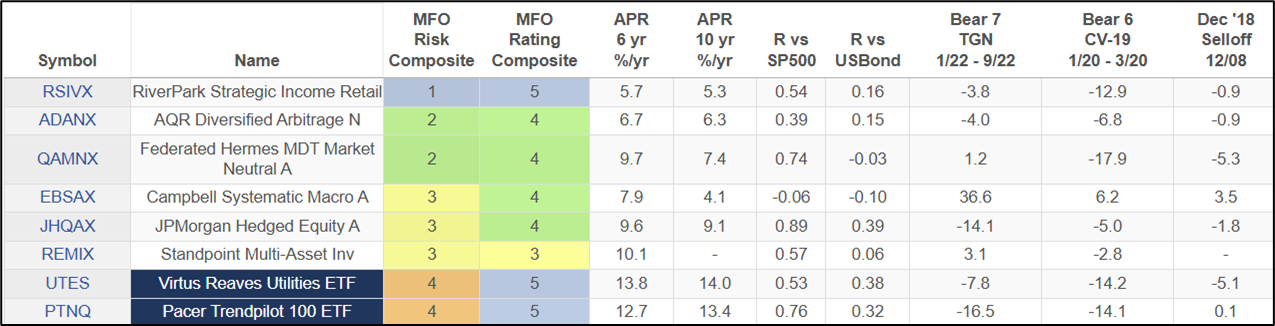
As a result of writing this article, I have identified the following funds as potential buy candidates for my conservative Core TIRA sub-portfolio during my mid-year review. Income will be a consideration. In the companion article this month, Perpetual Motion Income Machine, I narrow the list of alternative funds down to AQR Diversified Arbitrage (ADANX) because of its performance during the Great Normalization.

Table #5: Author’s Core TIRA Candidate List

Source: Author Using MFO Portfolios and Lipper Global Dataset

Closing

So, what have I learned on this exhausting quest for an elusive portfolio to guard against the sequence of return risk with minimally correlated funds? This tired traveler presents a Last Laugh portfolio as a possible candidate.  But I must emphasize that the financial landscape with the Great Normalization may have been a unique period with a dramatic rise in gold prices that may not be seen again.

As with most travel, the adventure is the trip itself and not just the destination. At the end of my journey, I return home to find the important truths of investing have been there all the time. Regardless of whether this time might have been different, the reliable approach for securing financial success is still built on the bedrock of: 

  1. Work with financial advisors to develop a lifetime budget and financial plan.
  2. Maintain an emergency fund.
  3. Commit to regular saving.
  4. Build a margin of safety into your financial plan.
  5. Assume that the current bull market is not going to last forever.
  6. Adjust discretionary spending down during bear markets and increase it when markets are high.
  7. Maintain diversified portfolios appropriate for your risk tolerance to avoid panicking and “selling low, buying high”.

Remember to balance daily life with long long-term savings. Life is precious – take time to enjoy it!

A special thanks goes to my long-time friend Dave H. in Spokane, Washington, for his many suggestions over the years. He has been a source of great ideas since I began writing financial articles a decade ago.

Quality Worked in 2025. And Failed Spectacularly

By David Snowball

Quality investing delivered one of its worst years on record in 2025. Except when it didn’t. Some quality funds posted top-quintile returns while many languished at the bottom, a divergence so dramatic it demands explanation. The story isn’t that quality failed; it’s that the market split quality investors into winners and losers based on a single tactical choice.

“Quality” funds in 2025

87 funds and ETFs have “quality” as part of their name; 60 of those 87 funds trailed their peers in 2025. Most funds that pursue “quality” as an investment strategy do not have the word in their name; we’re using these 88 to offer a snapshot of the larger quality universe.

Sixteen international funds have “quality” in their names; 11 of those 16 trailed their peers in 2025. So did nine of the 10 small cap “quality” funds.

But four of the five Great Owl funds with “quality” in their names outperformed. Great Owls are MFO’s designation for funds that consistently place in the top 20% of their peer group for risk-adjusted returns over pretty much all trailing time periods; three of the four outperformers were passive funds with GMO Quality as the active exception.

Best relative performers in 2025: Westwood Quality AllCap (8.4% above their peer group), FlexShares US Quality Large Cap Index (8.1% above), iShares MSCI USA Quality GARP ETF, a Great Owl fund (6.8%), FlexShares International Quality Dividend Dynamic Index, Invesco S&P International Developed Quality ETF, and GMO US Quality (all at 6%).

Worst relative performers: GQG Partners US Select Quality Equity (19.4% below their peer group) and WisdomTree International Hedged Quality Dividend Growth (16.8% below their peer group).

Best absolute performers in 2025: American Century Quality Diversified International ETF (up 38%), FlexShares International Quality Dividend Dynamic Index (up 37%), and FlexShares International Quality Dividend Index (up 35.3%).

Worst absolute performers: WCM Mid Cap Quality Value (-7.2%), WCM SMID Quality Value (-7%), and GG Partners US Select Quality Equity (-4.5%).

The outperformers list, both in relative and absolute terms, was dominated by passive strategies that didn’t have the option to second-guess themselves, succumb to career risk, or rotate anywhere.

GMO’s Ben Inker calls quality “the weirdest market inefficiency in the world.” High-quality companies with strong balance sheets, stable earnings, and disciplined capital allocation deliver superior returns with lower volatility than run-of-the-mill equities. It’s about the closest thing to a free lunch in investing. And yet, investors routinely overpay for speculative lottery tickets while neglecting these tangible but boring attributes.

We’ll walk through(1) why quality works over complete market cycles, (2) why it diverged so sharply in 2025, and (3) what that divergence means for investors going forward.

Why Quality Works

The evidence for quality’s long-term advantage is overwhelming and consistent across decades, geographies, and market conditions. GMO’s research spans three decades and shows that high-quality stocks offer 60% higher returns and 30% lower volatility than low-quality stocks. The pattern holds everywhere: high-quality cyclicals deliver 200% of the returns with 30% lower volatility than low-quality cyclicals; high-quality small caps offer 150% of the return with 30% less volatility; even high-quality junk bonds (BB-rated) offer 300% of the returns and 50% lower volatility than low-quality (CCC) junk bonds.

This isn’t a US phenomenon. Research from Europe and emerging markets shows identical results: quality delivered 15.0% annualized returns versus 8.4% for the benchmark, with lower volatility (14.2% versus 23.4%). Amundi Institute found that quality “delivers a statistically significant alpha that cannot be explained by loadings on conventional equity factors such as market, value, size, and momentum” across most world regions.

Recent validation from major institutions confirms quality’s endurance. The CFA Institute’s December 2025 study found that the MSCI World Quality Index outperformed the broader market in 100% of 10-year periods since 1998, a perfect record. Over rolling 10-year periods, quality beat the market 85% of the time, and outperformed growth stocks 85% of the time over decade-long horizons (versus only 49% on a quarterly basis). Lazard Asset Management’s 25-year analysis shows quality companies outperformed their regional peers everywhere: US companies by 260 basis points annually, emerging markets by 600 bps, Japan by 430 bps, and Europe by 300 bps.

But there’s a deeper mechanism at work beyond simple behavioral bias. GMO’s November 2025 analysis points to career risk as a key driver of persistent mispricing. Quality tends to lag during surging markets, causing managers to trail benchmarks and disappoint clients. For investment professionals judged on quarterly returns, quality’s long-term track record offers little comfort when they’re underperforming right now. This career pressure leads many managers to underweight quality despite knowing its long-term edge, reinforcing the very underpricing that creates the opportunity.

The asymmetry is striking: GMO’s Ben Inker notes that “high-quality stocks outperform low-quality stocks in down months by over three times the amount they underperform in up months!” The CFA Institute study confirms this pattern during the 2008-09 financial crisis: quality fell 33% peak-to-trough and recovered in just over three years, while growth stocks fell more than 40% and took more than five years to recover.

We tracked the performance of select quality funds through March 2024, charting their lifetime performance against peers. Without exception, these high-quality portfolios crushed their peers in the long term and when markets were at their worst. In rising markets, they made strong absolute gains while trailing quality-agnostic peers, the exact asymmetry that creates career risk for managers but long-term opportunity for patient investors.

Price matters, of course. Overpaying for quality cuts returns and reduces the margin of safety. GMO’s research tracking quality stocks back to 1928 shows that the cheapest half of the quality universe dramatically outperformed quality stocks purchased at any price. But Lazard’s research adds crucial nuance: in their 25-year study, the most expensive quality companies delivered solid but unspectacular returns (7.1% annually). Surprisingly, the cheapest quality companies performed worst of all (4.3% annually). The sweet spot was quality companies at moderate valuations (7.9-10.6% annually).

Why did cheap quality underperform? Persistence. Only 62% of the cheapest quality companies maintained their quality metrics in the following year, compared to 88% persistence for moderately-priced quality companies. The market often marks down quality companies for good reason, as perceived threats to their ability to sustain high financial productivity. As Lazard notes, “investors should be wary of buying the most expensive high-quality companies, you can overpay, even for a fundamentally robust company. At the same time, investors should be aware of the dangers of being seduced by very cheap valuations, often companies will be cheap for a reason.”

Why Quality Diverged in 2025

Quality didn’t fail in 2025; it bifurcated dramatically based on how managers navigated a market where speculation trumped fundamentals. The dispersion tells the story: GMO US Quality ETF (QLTY) gained 21.3% in 2025 while GQG Partners US Select Quality (GQEPX) fell 4.5%, a 26-percentage-point spread between two funds run by talented managers committed to quality principles.

Three distinct phenomena drove the divergence:

The Valuation Discipline Penalty

From our earlier analysis, we know that GQG entered 2025 expecting a market rotation from growth to value. They dumped quality tech holdings in favor of quality defensives, financials, healthcare, and industrials. It was a disciplined call grounded in valuation work: tech had gotten expensive, and quality investors shouldn’t overpay. The rotation never came. Tech mega-caps kept surging, and GQG’s defensive positions lagged.

GMO articulated the challenge in their November 2025 analysis: “The recent period of AI-related enthusiasm across markets has stretched expectations, particularly where narratives have overshadowed fundamentals. We see a risk that investors may conflate cyclical surges in capital expenditure with sustainable long-term profit streams.”

Their response? “Participate selectively through well-financed, diversified businesses with proven capabilities rather than speculative names.” In other words: stay with quality tech (Microsoft, Alphabet) that has proven capabilities, not speculative AI plays with lottery-ticket appeal. GMO kept their quality tech positions; GQG rotated to cheaper quality defensives, expecting mean reversion. Both managers were right about quality; GQG was wrong about timing.

The sector data confirms GQG’s tactical misstep. Among 2025’s quality fund outperformers, Information Technology appeared in two-thirds of top holdings while Utilities appeared in none. The worst performers concentrated in Industrials and Utilities, exactly where GQG rotated seeking cheaper quality. GQEIX’s top sectors are Utilities and Financials, a quality portfolio in the wrong sectors. GMO’s top sectors? Information Technology and Health Care. Both managers bought quality companies; GMO stayed where quality was scarce and valuable (expensive tech), GQG rotated to where it was cheap and unloved (defensives). In 2025’s speculative market, scarce quality commanded premiums for a reason.

Fidelity’s November 2025 perspective reinforces this evolution. Their managers emphasize that the old distinction between “blue chip” and “growth” has blurred: “Think of companies like NVIDIA, big, consistent growers that are incredibly high-quality businesses with incredible margins on cash flow and dominant share positions in their industry.” Quality in 2025 meant owning expensive tech, not rotating away from it.

The Speculation Surge

Small-cap quality collapsed in 2025. This reflects the same speculation-over-fundamentals dynamic at a different scale. Where large-cap quality managers could stay with proven mega-cap tech, small-cap quality managers faced a market dominated by unprofitable, high-volatility speculation.

Grandeur Peak’s data shows an 11% annual performance gap between high-quality and low-quality international small-caps, with low-quality winning. The chart is startling: over the five-year period ending 2025, the lowest quality quintile in international small and mid-caps dramatically outperformed the highest quality quintile. Grandeur Peak identifies the winners: “businesses related to bitcoin, precious metals, defense, quantum computing, and artificial intelligence.” These companies lack current profitability, stable cash flows, or any of the traditional quality metrics, but they soared on narrative and speculation.

Royce Investment Partners, managing small-cap quality strategies for decades, titled their November 2025 commentary “Waiting on the Small-Cap Quality Rebound.” They note that “the initial rebound for small-caps from this year’s low on 4/8/25 through the middle of the fourth quarter has so far been led by low quality factors such as stocks with low or no returns on invested capital and higher debt levels.” Their analysis shows that previous small-cap leadership phases started the same way, with early gains going to low-quality and high-growth stocks, but higher-quality companies taking over leadership as upswings matured.

International Quality: No Clear Haven

Some sources suggested international markets provided refuge from US speculation. JP Morgan’s Q3 2025 Factor Monitor claimed “absent this same phenomenon, international equity factors posted another strong quarter.” But our fund data tells a different story, with over two-thirds of our international quality funds underperforming in 2025.

However, Lazard’s long-term data shows international quality remains fundamentally sound. Over their 25-year study period, quality companies in international markets delivered substantial alpha against local peers, 600 bps annually in emerging markets, 430 bps in Japan, and 300 bps in Europe. The 2025 divergence appears to be a global phenomenon of speculation over fundamentals, not a US-specific dynamic.

Where Quality Goes From Here

Quality’s defensive value persists across complete market cycles. The CFA Institute’s December 2025 study noted that during the 2008-09 crisis, quality’s dividend yield (1.25%) was nearly double growth stocks’ (0.69%), meaning quality returns came from both price appreciation and income. More importantly, quality demonstrated “persistent returns,” longer sustained periods of outperformance when winning, which compounded gains over time.

Multiple sources point to attractive current valuations. Ruchir Sharma, writing in the Financial Times in November 2025, observed that “quality just suffered one of its worst relative declines ever in developed markets, lagging behind the broader market by almost 10 percentage points over the past year.” He notes that while US-dominated global stock market averages are pricey and trading well above their historical trend, “the quality corners of those markets are trading below trend.”

Leuthold Research’s November 2025 analysis shows quality versus junk performance back at long-term trend support, the same level that marked the last major bounce in 2021. GMO notes that quality has become “more inexpensive” in the US as speculative fervor drove money into low-quality names.

Major asset managers are positioning for recovery, not retreat. Fidelity’s November 2025 guidance encourages investors to keep “wish lists” of high-quality stocks they’d like to own if prices come down during volatility. “One of the big advantages I have is a long-term time horizon, which allows me to take advantage of volatility the market may provide on a short-term basis,” says Sonu Kalra of Fidelity Blue Chip Growth. The message: “With quality stocks, fortune favors those who wait.”

GMO’s positioning is similarly opportunistic. They acknowledge that “in an environment marked by uncertainty, elevated valuations, and rapid technological disruption, we believe quality is more relevant than ever. It provides a framework for navigating complexity, avoiding speculative excess, and anchoring portfolios in businesses built to last.”

The Strategic Choice: Staying Flexible Within Quality

The 2025 experience reveals an important lesson about executing quality strategies. Both GMO and GQG are excellent managers committed to quality principles, but they made different tactical choices that produced dramatically different results. The evidence suggests both approaches work over complete cycles but require different execution.

Lazard’s 25-year research offers guidance: valuation discipline adds significant value, but it must be nuanced. Their study found middle-valued quality companies (valuation deciles 2-8) delivered 7.9-10.6% annually with 75-90% persistence of quality metrics. The most expensive decile (7.1% annually, 88% persistence) and the cheapest decile (4.3% annually, 62% persistence) both underperformed.

This suggests a “Goldilocks” approach: avoid paying extreme premiums, but don’t be seduced by deep discounts that often signal quality erosion. The GQG experience in 2025 shows the risk of rotating away from expensive quality when quality commands premiums market-wide. The better strategy may be maintaining quality exposure while being selective about valuations within the quality universe.

Put differently: the “quality at a reasonable price” (QARP) approach works over time, but 2025 demonstrated that “reasonable” must be defined relative to the quality premium in the current market, not relative to historical norms. When quality is scarce and commands premiums broadly, insisting on historical valuation multiples means rotating out of quality entirely, which proved costly.

The Bottom Line

The consistency across independent sources is striking. CFA Institute, GMO, Fidelity, and Lazard, writing in late 2025 with different methodologies and timeframes, all reach the same conclusions: quality works over complete cycles, delivers superior risk-adjusted returns, and provides crucial downside protection when markets turn.

The 2025 divergence was painful for valuation-disciplined managers who rotated away from expensive quality tech, but it hasn’t changed quality’s fundamental advantages. The bifurcation revealed something important: in a speculative market where quality companies command premiums, the winning move was maintaining exposure to proven quality (even at elevated prices) rather than rotating to cheaper alternatives hoping for mean reversion.

For patient investors, the current setup offers an opportunity. Quality stocks have suffered one of their worst relative declines in decades and are trading below their historical trend relative to the broader market. As GMO frames it, quality provides “protection through the inevitable storms of the short term and superior compounding over the long term.”

The evidence supports measured optimism: quality works, current underperformance creates entry points, but success depends on maintaining exposure through difficult periods while remaining flexible about valuations. The GQG experience teaches that even great managers can be wrong about timing tactical rotations. The GMO experience teaches that staying with quality through expensive periods can work when quality remains scarce and proven capabilities matter.

Time and patience, as Fidelity notes, can do much of the heavy lifting. Quality’s record is clear: it wins over complete market cycles by crushing low-quality stocks when bad times hit, while lagging only modestly in surging markets. For investors who can tolerate short-term career risk, or who aren’t subject to quarterly performance reviews, the quality anomaly remains one of the most reliable sources of long-term alpha.

As Ben Inker puts it, we still don’t have a plausible explanation beyond “investors are weirdly stupid.” But GMO’s career risk framework suggests it’s more nuanced: investors aren’t stupid, but the incentive structures under which they operate systematically underprice quality’s long-term advantages. That’s not likely to change soon, which means the quality anomaly, “the weirdest market inefficiency in the world,” will likely persist for patient investors to exploit.

Minor disclosure: Chip owns the GMO US Quality Equity ETF in her non-retirement accounts (and is feeling smug about it); we have no financial interest in, or other relationship with, GMO.

Perpetual Motion Income Machine

By Charles Lynn Bolin

I skimmed through a couple of books for this article about income, searching for ideas. They tend to be very general, tell the reader how to get rich, or focus on risky investments like stocks and real estate investment trusts (REITs). Exchange-traded funds that invest in REITs averaged drawdowns of 38% during the past six years, while the S&P 500 had a drawdown of 24%. Ouch! I have a different perspective on income. Funds should have a high reward for the risk taken. The book that I related to the most was Income Factory – How You Can Live Off Your Dividends in the Future: Grow Your Income with Dividend Growth and Income Strategies (2025) by Sebastian Johnen, because he covered topics such as variability of distributions and sequence of return risk.  

If you have your savings in a savings deposit guaranteed by the FDIC (Federal Deposit Insurance Corporation), you have very little risk of losing your savings except to the silent thief known as inflation. These savings won’t cover 4% withdrawals over the long term. This article focuses on funds that produce high-risk-adjusted yields that lie between safe savings deposits and riskier stocks.

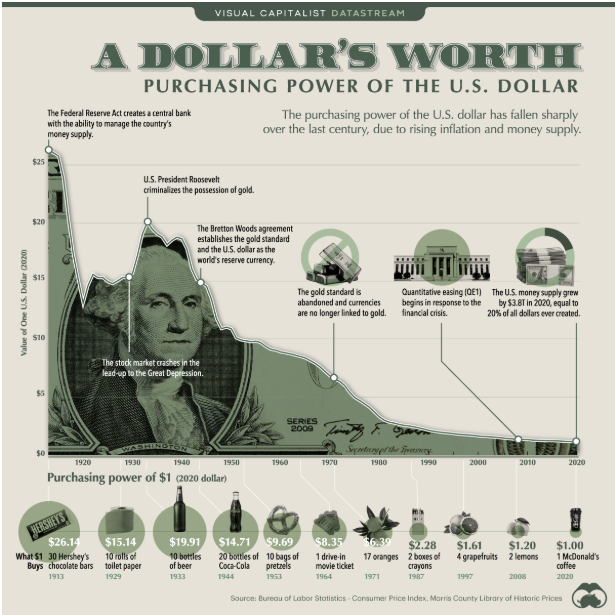
There are two parts to the Perpetual Motion Income Machine: 1) safe income to cover distributions, and 2) capital appreciation to beat inflation. The average inflation rate since the 1980’s has been about 2.3%. I am seeking minimum annualized returns of 7% to cover 4% withdrawals and capital appreciation of 3%. There have been three major secular bear markets (1929 – 1943, 1968 – 1978, 2000 – 2013) during the past one hundred years, when returns were low, so that most portfolios lost purchasing power and experienced a decline in portfolio value. The period from the COVID recession to the Great Normalization with inflation followed by rising rates offers a recent opportunity to study the sequence of return, although on a small scale.

Scope of This Article

For this article, I used Morningstar and Seeking Alpha to estimate historical prices, capital appreciation, and distribution yields over the past six to ten years for about a hundred funds from 41 Lipper Categories. The funds were selected because of their risk-adjusted returns (Martin Ratio), risk (Ulcer Index), and consistency (SIGMA %APR), among other criteria, through periods of low interest rates, rising or falling rates, inflation, and recession-induced bear market. Other than a few baseline funds, each had average annual returns of 4% or more for the past ten years or the life of the fund, whichever was shorter.

I divided the funds into four income groups based upon capital appreciation and average yields. Group #1 meets both of my objectives for capital appreciation greater than 3% and yields over 4%. Funds tend to be more aggressive, such as equity income, utilities, and mixed-asset growth. Group #2 meets the capital appreciation objective and produces yields between 2% and 4%. These funds tend to be a little less risky than Group #1 and include many of the same categories, along with consumer goods and more alternatives. Funds in Groups #2 and #3 tend to be less risky. Group #3 has positive capital appreciation and yields over 3%. Group #4 produces high yields, but capital appreciation is negative. The results are shown in Table #1.

Relative Standard Deviation (%RSD) measures the standard deviation (variability) relative to the mean in order to make more meaningful comparisons. Lower %RSD means the values fluctuate less. Distributions and yields may fluctuate with either the interest rate cycle or the stock market cycle. I used %RSD for distributions and yields, among other criteria, to select a short list of twenty-six funds to study further and fourteen income-producing alternative funds.

Table #1: Income Funds by Capital Appreciation and Yield

Source: Author Using MFO Premium fund screener and Lipper global dataset, Morningstar, Yahoo Finance

Lipper Categories

The term “high yield bonds” often draws a negative reaction from risk-averse investors. Riskier bond funds are not a replacement for quality bond funds. We are going to see in the following sections that many types of riskier debt are less risky than stocks and many mixed asset funds. I mostly focus on funds that have an MFO Risk rating of “Conservative” and “Moderate” with low Ulcer Index values, which measure the depth and duration of drawdowns. Here are some of the Lipper Categories and definitions for many of the funds presented in this article, sorted loosely for the funds that I track from lowest risk to highest:

Loan Participation: Funds that invest primarily in participation interests in collateralized senior corporate loans that have floating or variable rates.

Alternative Credit Focus: Funds that, by prospectus language, invest in a wide range of credit-structured vehicles by using either fundamental credit research analysis or quantitative credit portfolio modelling, trying to benefit from any changes in credit quality, credit spreads, and market liquidity.

Absolute Return Bond: Funds that aim for positive returns in all market conditions and invest primarily in debt securities. The funds are not benchmarked against a traditional long-only market index but rather have the aim of outperforming a cash or risk-free benchmark.

Multi-Sector Income: Funds that seek current income by allocating assets among several different fixed income securities sectors (with no more than 65% in any one sector except for defensive purposes), including U.S. government and foreign governments, with a significant portion of assets in securities rated below investment-grade.

Flexible Income: Funds that emphasize income generation by investing at least 85% of their assets in debt issues and preferred and convertible securities. Common stocks and warrants cannot exceed 15%.

Alternative Global Macro: Funds that, by prospectus language, invest around the world using economic theory to justify the decision-making process. The strategy is typically based on forecasts and analysis about interest rate trends, the general flow of funds, political changes, government policies, intergovernmental relations, and other broad systemic factors. These funds generally trade a wide range of markets and geographic regions, employing a broad range of trading ideas and instruments.

Income Fund Risk and Reward

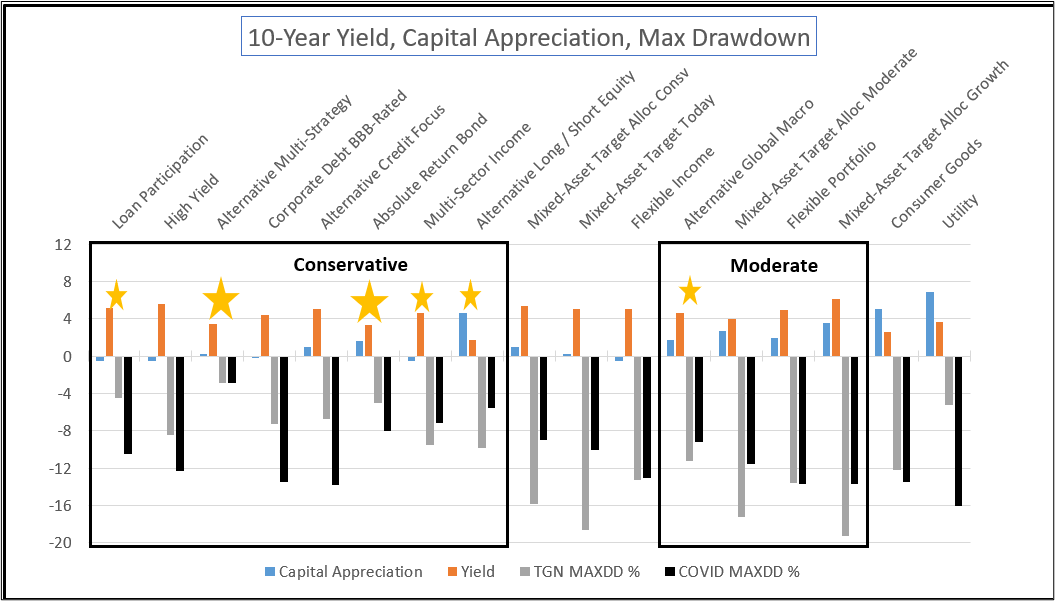
The most common Lipper Categories for funds that I researched with ten years of history are shown in Figure #1, sorted from lowest risk (combined composite MFO Risk and Ulcer Index) on the left to the highest on the right. Drawdowns during the COVID bear market are the black bars, and drawdowns during the Great Normalization with rising rates are the grey bars. Large gold stars indicate the Lipper Categories that had low drawdowns during both bear markets, and the smaller gold stars indicate categories that did moderately well.

Figure #1: Historical Distribution Yield, APR, and Drawdowns

Source: Author Using MFO Premium fund screener and Lipper global dataset, Morningstar, Yahoo Finance

Examples of funds in the categories with the large gold stars are BlackRock Systematic Multi-Strategy (BAMBX) with an average yield of 4.0% over the past ten years, and AQR Diversified Arbitrage (ADANX) with a yield of 2.8%. The key takeaway from the previous chart is that the sequence of return risk can be reduced by balancing allocations to funds that fluctuate according to the interest rate cycle and stock market cycle. Some alternative funds may reduce risk while also producing income.

Funds With High Risk Adjusted Yield

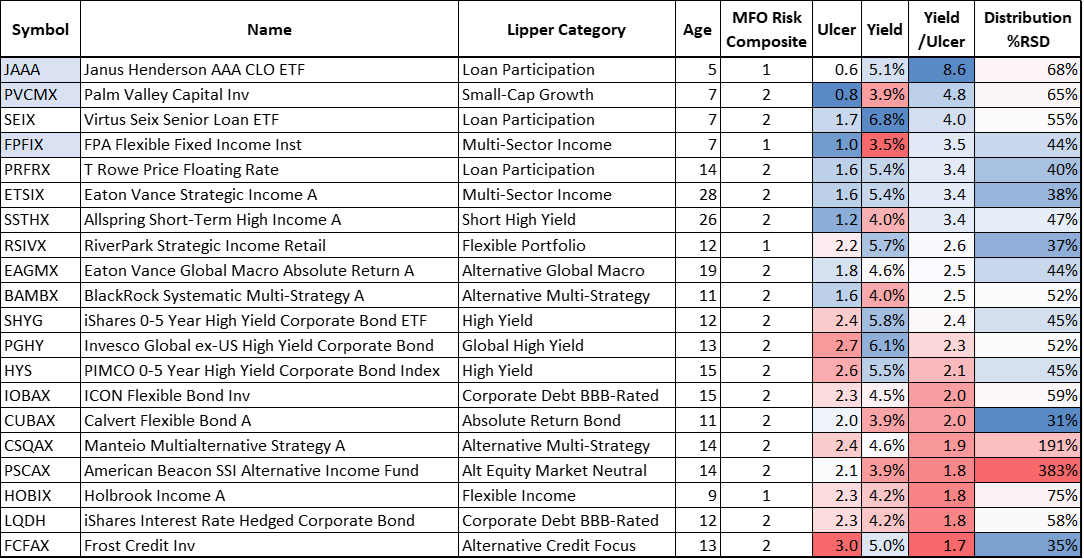
Table #2 contains a representative fund from Lipper Categories with the highest Yield/Ulcer Ratio, which happen to have MFO Risk Ratings of “Very Conservative (1)” and “Conservative (2)”. In addition, the distributions are fairly consistent as measured by “Distribution %RSD”. The investor share class for FPA Flexible Fixed Income Fund (FFIRX) is available at Fidelity. Palm Valley Capital Fund (PVCMX) is an interesting fund. It is about 22% invested in 23 small-cap stocks, with the rest invested mostly in cash and Treasury bills. I own shares in both of these funds. I own shares in the three funds shaded blue.

Table #2: Funds With High Risk Adjusted Yield

Source: Author Using MFO Premium fund screener and Lipper global dataset, Morningstar, Yahoo Finance

Income Groups by Capital Appreciation and Yield

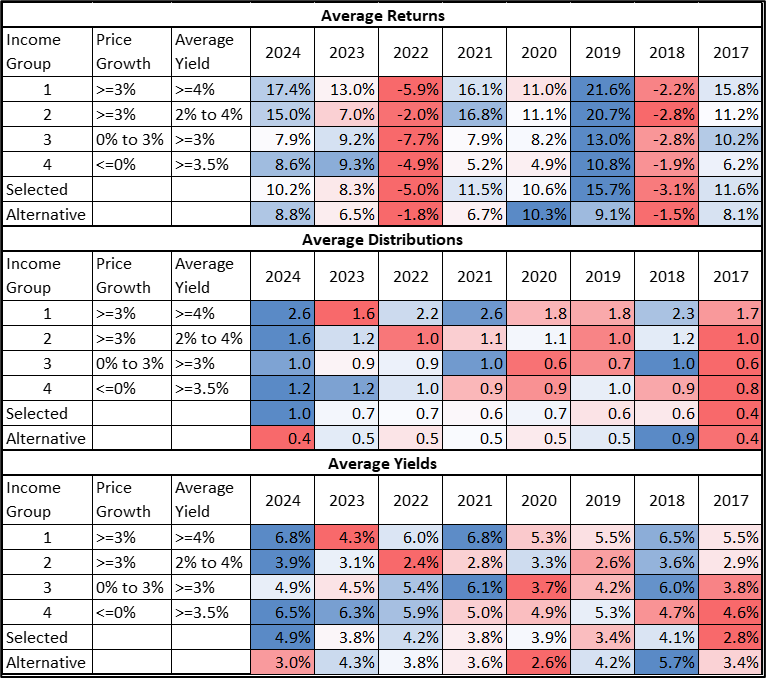
High average yields are great, but if an investor wants to depend upon steady distributions, they may need to mix funds with different income characteristics. Table #3 contains average annual returns, distributions, and yields for nearly one hundred. Returns are noticeably lower during 2018 and 2022 and higher in 2019. Distributions for Group #1 tend to fluctuate the most, while they are more stable in the other three groups. Yields tend to fluctuate a lot because they are estimated from both distributions and prices. It is important for investors who need to rely on distributions to use a safe investment, such as money market funds, to act as a buffer for when distributions are low. Bond ladders can also act as buffers.

Table #3: Income Groups by Capital Appreciation and Yield

Source: Author Using MFO Premium fund screener and Lipper global dataset, Morningstar, Yahoo Finance

Minimum Expected Returns

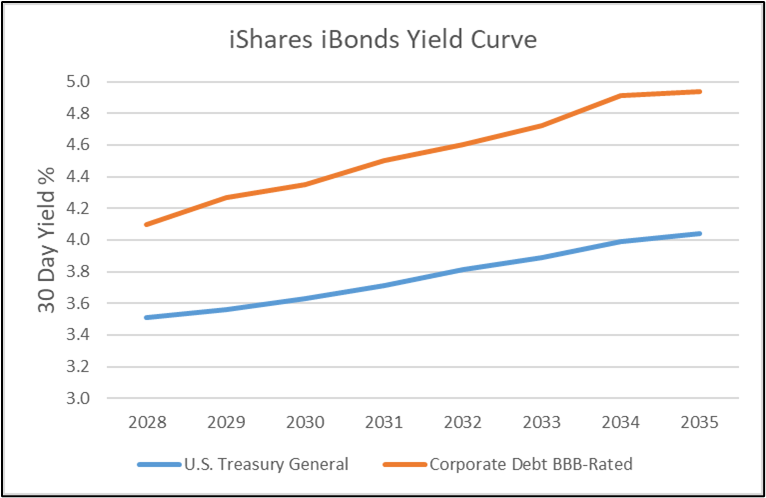
Figure #2 shows the yield curve for iShares iBonds with target date maturities. iShares iBonds corporate bond ETFs that mature in 2034 and 2035 are yielding nearly 5% and about 1% more than Treasuries. They get more conservative as their maturity dates get closer. At this point in time, I can lock in yields of 4% or higher for the next ten years with bond ladders. I used this as a threshold that every fund evaluated had to have returns of 4% or higher over the past ten years, otherwise adding to the bond ladder is a good alternative.

Figure #2: iShares iBonds Corporate and Treasury Yield Curves

Source: Author Using MFO Premium fund screener and Lipper global dataset

Author’s Selected Funds

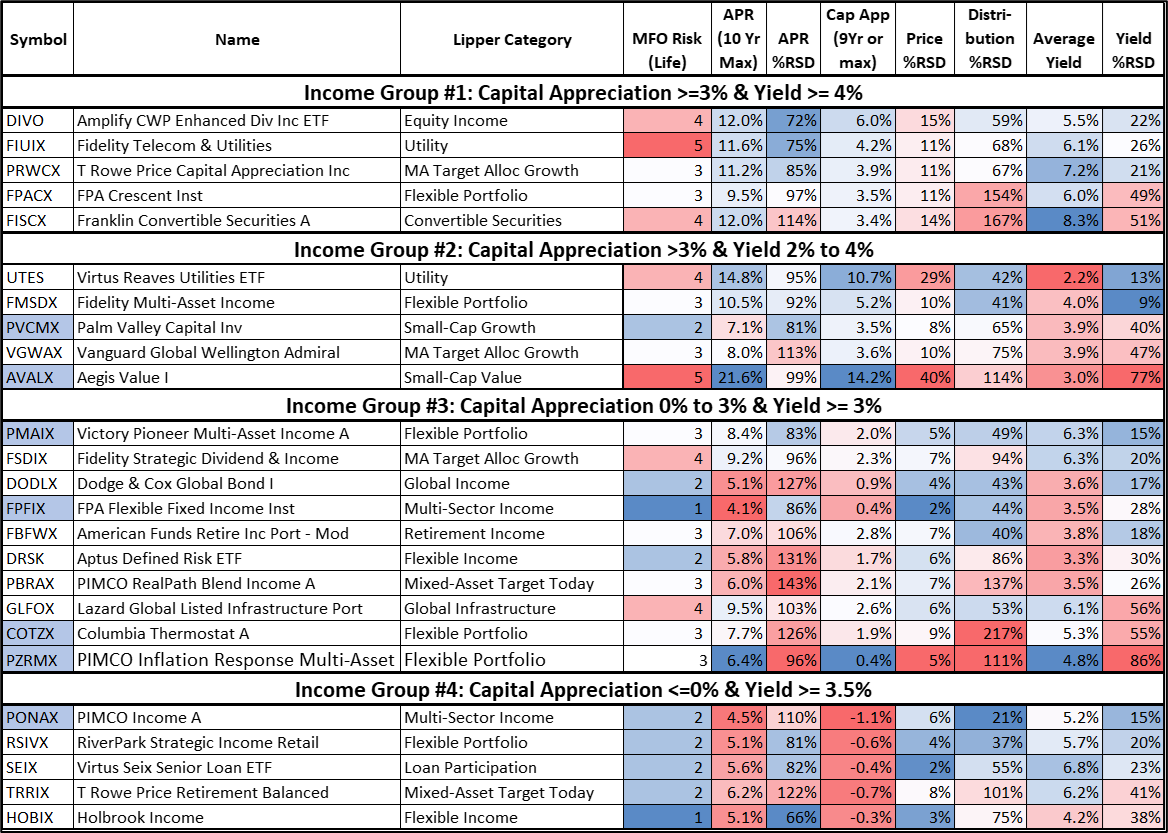
Table #4 contains the funds in my short list. The fund symbols shaded blue are in the Core TIRA portfolio. Metrics shaded blue are more favorable, while the red ones are less favorable. Metrics are based on the past ten years or the life of the fund, whichever is shorter. Capital appreciation is calculated from 2016 to 2025.

Table #4: Author’s Shortlist of Income Funds

Source: Author Using MFO Premium fund screener and Lipper global dataset, Morningstar, Yahoo Finance

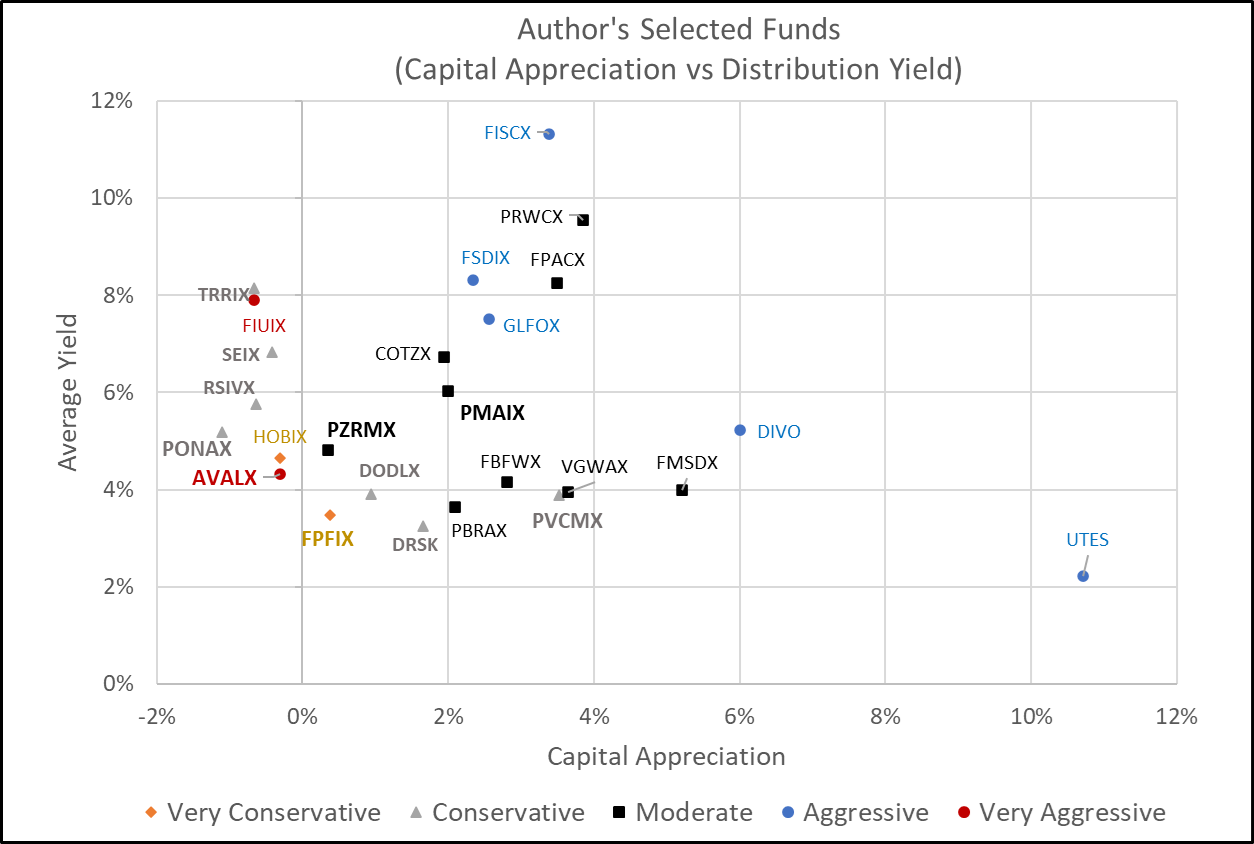
The funds are shown in Figure #3. The six larger, bold funds are in the Core TIRA. While I like Virtus Reaves Utilities ETF (UTES) for its total return, Fidelity Telecom & Utilities (FIUIX) makes more sense from an income perspective. I am considering Fidelity Multi-Asset Income (FMSDX) and T Rowe Price Capital Appreciation Income (PRWCX) for my mid-year review.

Figure #3: Author’s Shortlist of Income Funds – Capital Appreciation vs Yield

Source: Author Using MFO Premium fund screener and Lipper global dataset, Morningstar, Yahoo Finance

Perpetual Motion Income Machine

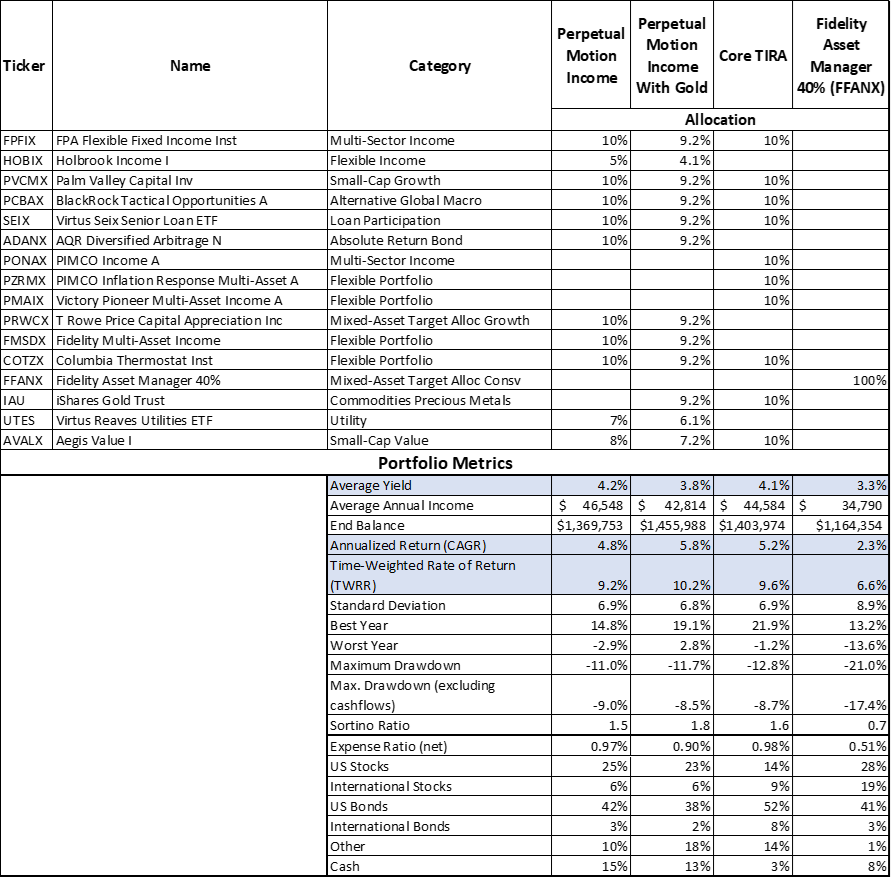
Table #5 contains the Perpetual Motion Income Machine Portfolio with and without iShares Gold Trust (IAU) compared to the Core TIRA and Fidelity Asset Manager 40% (FFANX). The assumptions include 4% annual withdrawals. The Core TIRA holds up well. There are advantages to each of the three depending upon whether you prefer total return or income. With perfect hindsight, all three outperform the Fidelity Asset Manager 40% (FFANX). The link to Portfolio Visualizer is provided here.

Table #5: Perpetual Motion Income Machine Portfolio (May 2019 – Dec 2025)

Source: Author Using Portfolio Visualizer

Note: I substituted Virtus Seix Senior Loan ETF (SEIX) for Janus Henderson AAA CLO ETF (JAAA) in the Core TIRA in order to evaluate a longer time period.

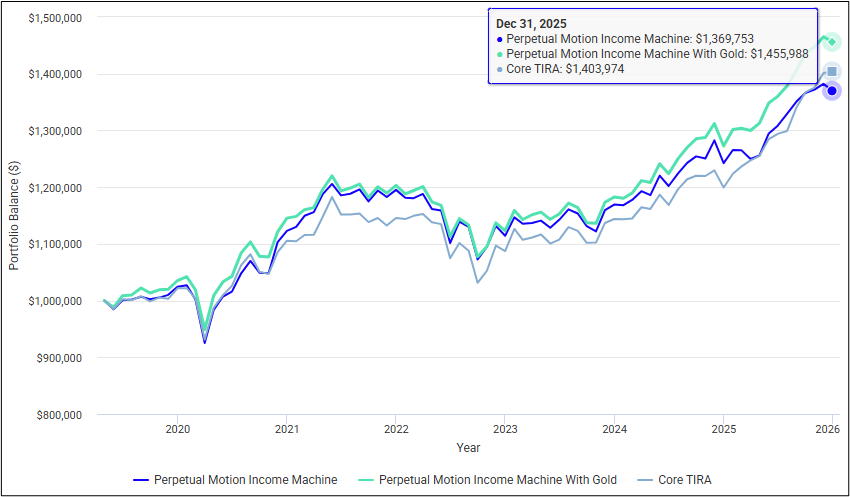
Figure #4 shows the results graphically. All would have been subject to loss of inflation-adjusted purchasing power because of inflation and the Great Normalization.

Figure #4: Perpetual Motion Income Machine Portfolio

Source: Author Using Portfolio Visualizer

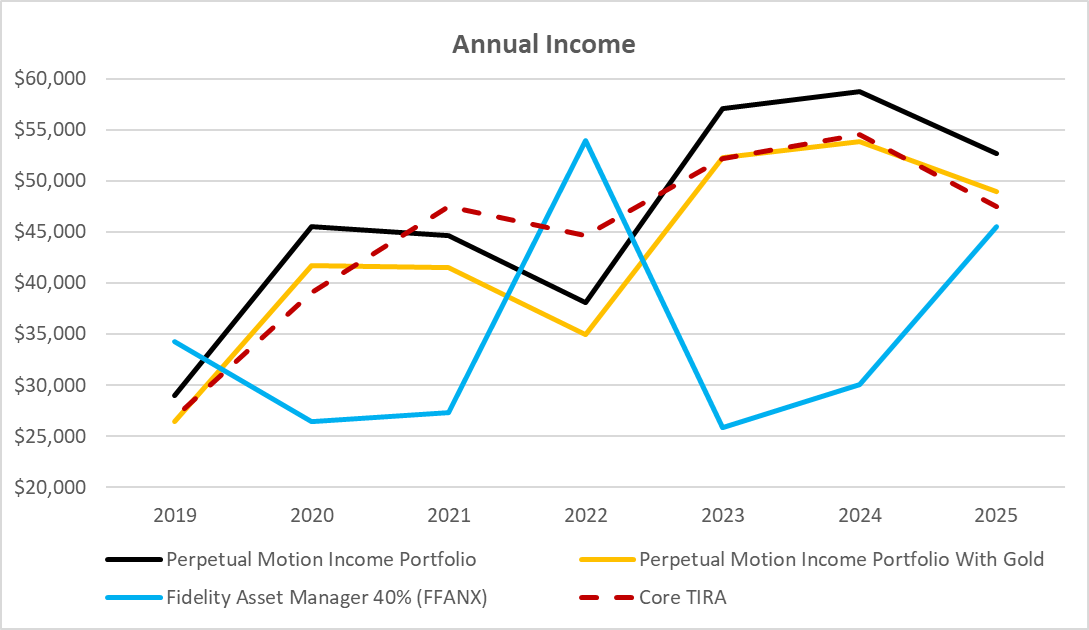
The Perpetual Motion Income Machine Portfolio was designed to produce a steady income, which is evident in Figure #5. Having more funds within reason smooths out distributions. The dip in 2022 might have been reduced with Fidelity Series Real Estate Income (FSREX) or an international equity fund (DBEF, LVHI).

Figure #5: Perpetual Motion Income Annual Income

Source: Author Using Portfolio Visualizer

Funds for Mid-Year Review

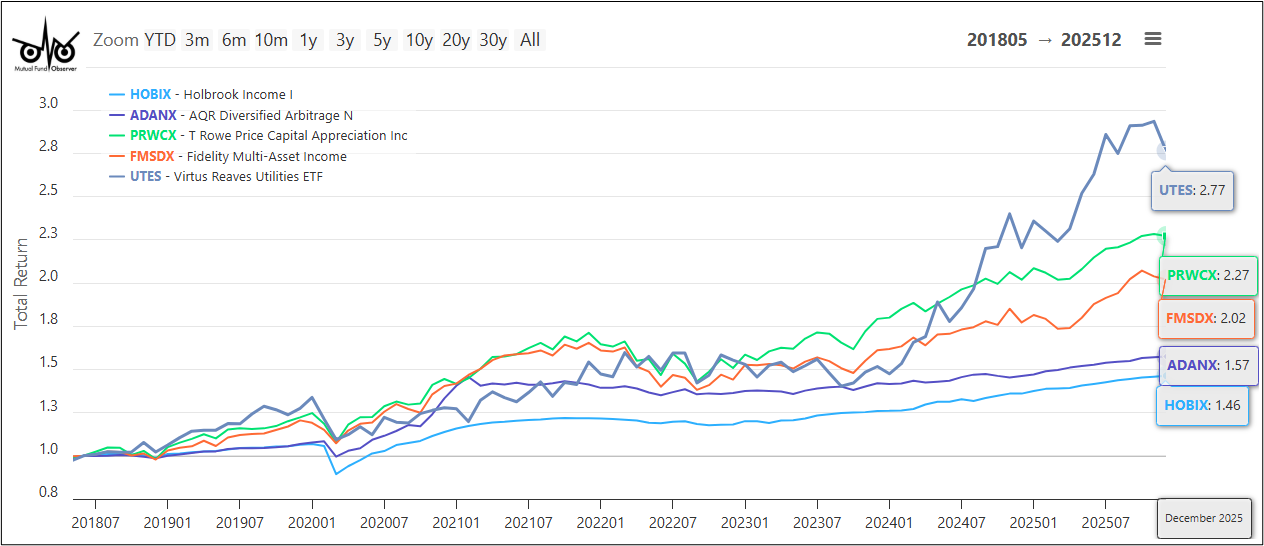
The Perpetual Income Portfolio has five new funds compared to the Core TIRA, one of which is an alternative fund. I will evaluate these at mid-year when a bond matures. The funds are shown in Figure #6.

Figure #6: New Funds in Perpetual Income Portfolio

Source: Author using MFO Premium fund screener and Lipper global dataset.

Closing

Over the past two years, I recognized that my overall stock to bond ratio was higher than the long-term environment justified, lowered my risk profile with financial advisors, adapted the concept of having aggressive and conservative Traditional IRA sub-portfolios, adapted the concept that a portfolio can extend across more than one account, realized that my bond ladder is an integral part of the conservative Traditional IRA sub-portfolio, and changed my strategy to have each rung in a ten-year bond ladder contain 3% of the portfolio value. It will take several years to wind down my bond ladder to 30% of the portfolio value. The Core TIRA will evolve slowly.  

With the Bucket Approach, the short-term bucket contains safe short-term funds to meet spending needs for the next three years and to cover emergencies. For this reason, I may be too conservative in the Core TIRA Portfolio because I developed it as a standalone portfolio. The Core TIRA has 23% allocated to stocks. I would like to increase this a little over time. I have three funds identified to consider adding during my mid-year review: 1) T Rowe Price Capital Appreciation Income (PRWCX), and 2) Fidelity Multi-Asset Income (FMSDX). AQR Diversified Arbitrage (ADANX) has also caught my attention.

The Perpetual Motion Income Portfolio doesn’t entirely eliminate the sequence of return risk from the silent thief inflation, nor a secular bear market. It does provide enough income to cover withdrawals so that no funds would have to be sold in a down market. Bond ladders provide an additional buffer to the variability of distributions. It is important to build a margin of safety into financial plans.

A Letter to Layla

By David Snowball

Hi, Layla.

Chip and I are grateful for the help you’ve given us in learning to be a bit more physically fit, and we were delighted to hear that you were interested in learning a bit about … umm, financial fitness. I know it seems confusing and infinitely complex.

It isn’t. Really, you just need to have a bit of faith, a bit of discipline, and a willingness to get started. Not that hard. And, happily, many of the disciplines that you’ve learned as a physical trainer carry over almost perfectly into understanding this new adventure.

About Layla

Layla Summerhays, a native Utahan, is an NASM Certified personal trainer and a staff trainer with the YMCA of the Iowa Mississippi Valley. Chip and I began working with Layla in September 2026. When we aren’t completely out of breath, we chat about life and goals, plans and aspirations. Recently, Layla volunteered that she had pretty much mastered the household budget, had set for herself the goal of learning about investing, but wasn’t quite sure where to start. I popped my hand up, at least in part to distract her from overseeing another round of “dislocators” and “dead bugs.” (Gym people have such a way with words.

This letter is written, in part, as thanks to Layla for all her time and patience in trying to help Chip and me reach one set of goals. It seemed only fair to help her learn to meet another. In a larger sense, of course, this is gentle guidance and cheerleading for an entire generation of young people who are so inundated with noise and racket – inexplicable headlines about cryptocurrencies and meme stocks and imminent catastrophes – that they’ve lost faith in their own ability to do one, simple thing: take the first step.

And so, to them all, have faith. Be brave. For now, you just need to set your feet on a path, breathe, and take one step forward. You’ve got this.

What sorts of things? Oh, start by finding the place that matches your needs – not all of us need the $300/month for access to Equinox (who knew?), have an honest talk about your needs and challenges, make a plan, start gradually, and build as you get comfortable and, most of all, be ready to forgive yourself. There will be lots of times when you have a setback or months where money’s tight (or where temptation rears its ugly head), and that’s okay.

Same thing with investing, really.

  1. Pick the right platform. Almost all investments are purchased through a third-party platform these days, rather than directly from a manager. That’s good since a good platform will offer one-stop shopping with lots of options under one roof, plus they’ll do the record-keeping for you, which is useful at tax time.

    My choice is Charles Schwab. Setting up an Individual Brokerage account there is free and takes about five minutes. Why Schwab? I backed into it (they bought the company that bought the company that bought the company that I originally chose many years ago), but they remain a fine option for do-it-yourself investors who aren’t looking for lots of (often expensive) hand-holding.

  2. Set your goals and priorities. What are you trying to accomplish? How urgent does this stuff feel? How much time do you realistically have to fool around with it? How much can you invest just now?

    One strategy to consider: buy a physical journal and write down your goals (“$1000 emergency fund by year’s end”) and commitments in it. Check in every couple of months, add notes about an experience or a change in your circumstances. Use it as external evidence of your internal pledge.

  3. Become a conscientious consumer. Your investments exist as a tool to help make sure that your resources are sufficient to cover your needs. One way to help achieve that goal is to be thoughtful about what you decide you “need.” In the US alone, marketers spend about half a trillion dollars a year trying to convince you to buy stuff, and they mostly succeed.

    For example, we own about three times as many outfits as the generation did 50 years ago (30 outfits vs. 9), we acquire about 70 new items of clothing a year (versus 25), we wear each item half as frequently and keep each one about half as long as they did, and discard about 80 pounds of clothes annually into landfills. Marketing researchers report that about 40% of clothing purchases are made on impulse. (They both celebrate and depend on your impulses, by the way.)

    That explains, in part, why 40% of American adults don’t think they could find $400 to cover a short-term emergency.

    Two strategies to consider: (1) buy the highest quality goods you can afford but don’t plan on buying a lot of them, and (2) use a 48-hour rule for online shopping. If you put something in your cart, do not click “buy now.” Wait 48 hours, go back and see if you still want it.

  4. Set up your “sleep well” fund. You’ll sleep better if you know that you’d be just fine if you couldn’t – or didn’t want to – work for a couple months but still needed to pay your durn bills. So start by asking, “How much would I need to cover the essentials for the next six or eight weeks,” and target that for your emergency fund.

    Look for a fund with a history of making more than inflation (say 3% a year) that pretty much never loses money.

    At Schwab, check out RiverPark Short Term High Yield Fund (ticker symbol: RPHYX). Over the past five years, RiverPark has made about 4% a year with essentially zero losses ever (technically, it was down 0.22% for a month then rebounded). That compares to an average of 0.2% on a bank savings account. (Avoid them, really.)

    Alternately, consider Schwab Prime Advantage Money Market (SWVXX), which has returned 3.2% with absolutely no downside and lower expenses.

    To buy it: log into Schwab, search for RPHYX or SWVXX, click ‘Buy,’ enter your amount (minimum $1), and confirm. That’s it—you just became an investor. Here’s the pro tip: you want to automate the process, tell Schwab to draw $100/month from checking and put it automatically into your sleep well fund. Don’t trust yourself; think about all of those people whose New Year’s resolution was to go to the gym and ask, “How many of them are still showing up in February?” Automatic investing = automatic discipline = you win. When it hits your target, redirect that monthly amount to your eat-well fund.

  5. Set up your “eat well” fund. That is, begin building the nest egg that you might want to draw on in 15 or 20 or 40 years, money for retirement or adult mischief (“I want a getaway in the mountains”). The two sides of a long-term fund are that (1) you make a lot of money in the long-term, but (2) only if you don’t look at it in the short-term.

    Over the (very) long term, stocks return about 10% a year. That adds up dramatically: if you invest $1000 this year and let it grow at 10% a year, you would end up with $73,000 by retirement. If you invest $100 to start and add $100 a month, you’re around $870,000.

    The catch? Markets swing wildly in the short term—losses of 40% in a year are possible, and gains of nearly 50% are too. It’s why most people fail at this: they panic and sell at the bottom. But if you can commit to ignoring those swings and just keep contributing every month, the long-term math is nearly unstoppable. That’s what T. Rowe Price Retirement 2070 (TRVSX) is designed for: it starts out super-aggressive and then gradually dials back risk as you get closer to retirement. $1 gets you in.

    If you want something for goals that are years, rather than decades, away, look at a fund that combines some stocks (for growth potential) with some bonds or cash (for stability in bad markets). Chip and I chose FPA Crescent (FPACX) and Leuthold Core (LCORX or LCR, depending on whether you want a mutual fund and an ETF). Crescent made 11.1% over the past five years, but did suffer a worst loss of 17%. Leuthold made 8.5% with a worst loss of 12.9%. Rock-solid teams with an entirely admirable aversion to losing money. “But they lost money!” you cry? Well, yes. Welcome to stock investing.

    $1 is all it takes to start. Discipline is what it takes to stick with it.

  6. Don’t injure yourself. Please. In a gym, you can injure yourself by pushing too hard, too fast, or by using equipment you don’t fully understand. Once you’re injured, you end up in pain, with an immediate disruption of your goals and, likely, with an enduring hesitation. “I tried going to the gym, but it really didn’t work out, and so I haven’t been back in years.”

    Investing is the same, dear friend. There are a thousand people out there trying to sell you on dangerous, untested, unnecessary, and expensive schemes: cryptocurrencies, can’t-miss “meme” stocks, funds that double down on the returns of a single stock, funds that invest in “disruptive technology” or “the AI revolution.” Here’s what we know about such investments: they make a huge amount of income. For the people who sell them. What about the folks who buy them? Mostly, they get injured.

Give yourself a goal. Open a Schwab account. Start your sleep well. Add a bit every single month (that you can). Once that feels doable, start your eat-well. Add a bit every single month (that you can). Don’t succumb to the temptation to roll the dice and get rich quickly.

You’re young. If you start now with just $100/month in TRVSX, you’ll have close to a million dollars by retirement—without ever thinking about it again. That’s the power of starting early. You’ve got this.

And if this all seems a bit too much like “eat your broccoli,” give yourself a little cash stash – take $10 or 20 from each paycheck, tuck it in a drawer, and use it for entirely unnecessary, irresponsible activities that make you smile. Knowing that you’re getting some rewards now makes the discipline of being strong and focused a lot more bearable.

That’s it. That’s the whole secret. Discipline to set it up, discipline to keep contributing, discipline to ignore the noise. And then—this is the important part—go enjoy life. Laugh with your friends. Build your career. Travel when you can. Love well. The portfolio’s job is to make sure money never stops you from doing those things. Your job is everything else.

You’ve got this.

Be well. Have faith,

david's signature

The Indolent Portfolio, 2025

By David Snowball

A tradition dating back to the days of FundAlarm was to annually share our portfolios, and reflections on them, with you. My portfolio, indolent in design and execution, makes for fearfully dull reading. That is its primary charm.

This is not a “here’s what you should own” exercise, much less an “envy me!” one. Instead, it’s a “here’s how I think. Perhaps it will help you do likewise?” exercise.

My portfolio and my life

By design, my portfolio is meant to be mostly ignored for all periods because, on the whole, I have much better ways to spend my time, energy, and attention. For those who haven’t read my previous discussions, here’s the short version:

  1. Your portfolio doesn’t love you; your family does. Give them your time.
  2. The market doesn’t need you; the world does. Give it your attention.
  3. “Beating the market” is completely irrelevant to me as an investor and completely toxic as a goal for anyone else. You win if and only if the sum of your resources exceeds the sum of your needs. If you “beat the market” five years running and the sum of your resources is less than the sum of your needs, you’ve lost. If you get beaten by the market five years running and the sum of your resources is greater than the sum of your needs, you’ve won.

That might be the single most important perspective you can take away this month. Investing is about having reasonable security in support of a reasonably rich life. Not yachts. Not followers. Not bragging rights. Life.

“Winning” requires having a sensible plan enacted with good investment options and funded with some discipline. It’s that simple.

My portfolio is built to allow me to win. It is not built to impress anyone.

My portfolio and stocks

Frankly, I have never made a fetish out of “stocks for the long run.” I view stocks in about the same way that I view chiles in my chili: the first half dozen are delightful, and after that they’re disastrous. (Chip, Will, and I were dining at a Vietnamese restaurant last year, and the owner quietly asked Will, “Do you mean white people spicy or Asian spicy?” Unable to lose face, Will made the choice that prevented him from tasting anything for the following three days.)

Source: my visit to Albuquerque to speak to the AAII chapter (2017)

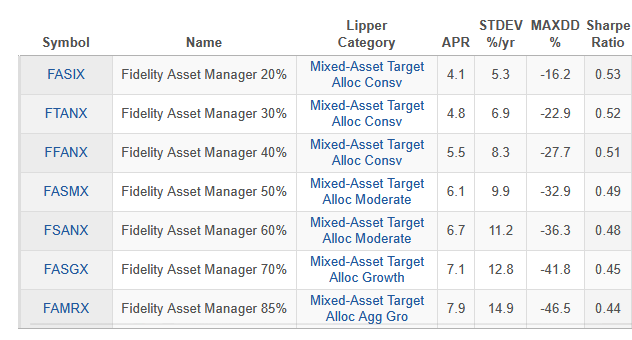
Stocks are like that. In just about any rolling 20-year period, adding stocks to your portfolio (a) raises its total return and (b) lowers its risk-adjusted return. Why? Because stocks are given to bouts of crazy volatility that cause investors to do incredibly self-destructive things. One illustration is the performance of Fidelity’s Asset Manager suite of funds, which differ primarily in how much equity exposure (20 – 85%) is permanently built into the fund.

Asset Allocation Implications – Great Financial Crisis to 2025

Source: MFO Premium

Over the past 18 years, your risk-adjusted returns (measured by the Sharpe ratio) fell consistently as your stock exposure rose. That’s anomalous only in this sense: usually, the decline in Sharpe and the gap in maximum drawdown are far larger than this table shows because this period captured an unusually severe bear market for bonds.

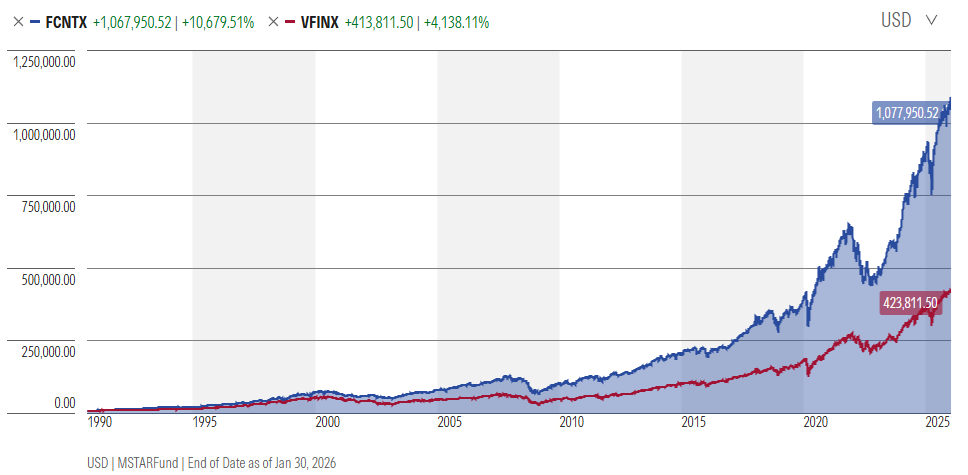
Since its inception, Fidelity Asset Manager 50% has returned about 8% with a volatility of about 9%.

Performance since inception of Fidelity’s 50% solution

And so I reached The 50% Solution. “50% what?” you ask? 50% everything. My portfolio targets 50% equity and 50% not, which translates to 50% growth and 50% stability. My equity portfolio targets 50% US and 50% not. My stability portfolio targets 50% bonds and 50% not.

That works for me!

My year-end 2025 allocation

Domestic equity Close enough Traditional bonds Underweight
Target 25% 2025: 23% Target: 25% 2024: 11%
Also managed a 45% large cap / 55% small to mid-cap weight. The low number here and high cash weight purely reflect my liquidation of two income-oriented T Rowe Price funds.
International equity Overweight Cash / market-neutral / liquid Overweight
Target 25% 2025: 33% Target: 25% 2025: 33%
This has been a pretty long-lasting overweight. The average US investor has 15% of their equities in international stocks, while I’m targeting 50% and sitting at 60%. Rather a lot of my managers have found reason to hold a lot of cash of late. FPA, Leuthold, and Palm Valley all sit at or above 20%.

Here’s what that looks like in terms of performance and volatility.

Indolent portfolio Annual return Max Loss Standard Deviation Sharpe Ratio Ulcer Index
2025 13.9 -1.1 4.3 2.23 0.2
Three year 11.1 -5.3 6.4 1.00 1.2
Five year 6.4 -15.9 7.6 0.41 5.3

The five-year performance looks bad because it includes 2022, when the stock market dropped 23%, and the bond market fell 13%. The Indolent Portfolio did better than either in 2022 and about 4% better than a hypothetical portfolio with the same weightings. And that’s been true most years: 1-2% better than a peer-weighted portfolio, 6-9% returns, volatility in check.

My investment choices

I own 10 funds. Yes, I know that’s more than I need. Some of the sprawl represents my interest in tracking newer and innovative funds, some represents a tax trap (I have a lot of unrealized gains), and some is indolence. A fund is doing fine, so why bother to change? The common theme across my fund is that I trust the managers implicitly. Andrew Foster, Steve Romick, Eric Cinnamond, David Sherman … I’ve had the pleasure of talking at length, about investing and life, with all of them. I trust them with my money, and  in some ways, also “with my future.” They’ll have good years and other ones, and I’m comfortable with that.

In general, my core funds are equity-oriented, but the managers have the freedom (and the responsibility) to invest elsewhere when equities are not offering rewards that match their risks.

Core growth funds – 2025

    Weight APR Max Loss Standard Deviation
FPA Crescent Flexible Portfolio 22% 21.0 -3.1 6.1
Palm Valley Capital Small-Cap Growth 7 4.5 -1.2 3.4
Leuthold Core Investment Flexible Portfolio 6 14.4 -4.8 8.3
Brown Advisory Sustainable Growth Multi-Cap Growth 5 3.5 -12.9 16.7

Leuthold and FPA are two very different versions of disciplined “go anywhere” funds; each seeks equity-like returns with sub-market risk. Leuthold is a quant fund; FPA’s bias is “absolute value.” Palm Valley Capital is the fourth incarnation of Eric Cinnamond’s strict small-cap discipline: he loves great stocks but would rather sit on hot coals than buy stocks that aren’t priced for exceptional gains. Lots of cash for long periods, which is frustrating for some and just fine for me. Brown Advisory was my choice for the best sustainable equity fund I could find.

Core income / market neutral funds – 2024

  Category Weight Return Max loss
T Rowe Price Multi-Strategy Total Return – fund liquidated Alternative Multi-Strategy 0%    
T Rowe Price Spectrum Income – position liquidated Multi-Sector Income 0    
RiverPark Strategic Income Flexible Portfolio 7.0 6.3 -0.7
RiverPark Short Term High Yield Short High Yield 7.0 4.4 0.0

I bid a sad farewell to my two T. Rowe Price funds. Price chose to liquidate Multi-Strategy Total Return, which was designed to operate like a hedge fund, and had changed Spectrum Income’s strategy to eliminate its ability to hold high dividend stocks. I moved the entire Price portfolio to cash, which returned about 5%. And the two RiverPark funds are low-risk, credit-oriented investments. Short Term made money in 2022 when everything else faltered.

That whole “international overweight” thing – 2025

  Category Weight Return Max loss
Seafarer Overseas Value International Small / Mid-Cap Value 7.0% 37.8 0.0
Grandeur Peak Global Micro Cap Global Small- / Mid-Cap 14.0 13.2 -4.1
Seafarer Overseas Growth and Income Emerging Markets 9.0 32.5 -0.3

In general, I’ve never understood why buying shares of large multinational corporations nominally headquartered in London would logically produce results different from buying shares of large multinational corporations nominally headquartered in Boston. As a result, my impulse was to look at smaller markets and smaller companies. In theory, that should work splendidly. In 2025, it made me look a lot smarter than I am.

Tasks for 2026

Invest the cash in my T. Rowe Price account. Given my age and the rest of my investments, there’s a limited argument for much equity exposure, so I screened for Price funds with decent Sharpe ratios and limited downside. One stands out; one is a possibility.

Five-year performance for two Price portfolio candidates

Alternatively, I could leave my cash in a high-yield money market (its current home) or transfer it to Schwab, where I have a broader array of choices. Research continues.

Figure out the Grandeur Peak story. Talk about a fall from grace. Grandeur Peak, for years, could do no wrong. Their founder went on a five-year sabbatical to work with his church; most of their funds suffered. As of July 2025, he’s back and has added himself as co-manager on Global Micro-cap.

Think about whether it’s a brave new world. It won’t make a world of difference, but the argument that the US has surrendered its financial primacy in global markets – both equities and income – as a result of fiscal irresponsibility and speculation, might encourage some internal shifts as I work toward responsible, risk-conscious investing.

Alternatives to my choices

It’s not necessary to own more than two or three funds to create an indolent portfolio. The key choice is whether you want to build substantial cash (or cash-like securities) into the mix or stick with stocks and bonds alone.

The Bogleheads endorse a three-fund portfolio, which does not consider “cash” to be an investment. Their process has two steps: (1) pick the asset allocation that’s right for you and (2) buy three low-cost index funds that give you exposure to the assets you’re seeking. Their default set is:

  • Vanguard Total Stock Market Index Fund (VTSAX)
  • Vanguard Total International Stock Index Fund (VTIAX)
  • Vanguard Total Bond Market Fund (VBTLX)

Step One – “figure out your asset allocation” – is the tricky one there. A very simple two-fund portfolio – one flexible fund in the hands of a top-tier manager and one incoming producing fund similarly skippered – split 50/50 could replicate my portfolio and would require negligible maintenance.

The small investors indolent portfolio

  Lipper Category Weight APR Max Loss
Portfolio 100.0% 9.4 -2.4
RiverPark Short Term High Yield Short High Yield 50 4.4 0.0
Leuthold Core Investment Flexible Portfolio 50 14.4 -4.8

Alternately …

  Lipper Category Weight APR Max Loss
Portfolio 100.0% 12.0 -1.9
FPA Crescent Flexible Portfolio 50.0% 17.6 -3.1
RiverPark Strategic Income Flexible Portfolio 50.0% 6.3 -0.7

Why not Fidelity Asset Manager 50%, since I’ve used that as a benchmark? The short answer is that the fund’s income exposure is entirely US Treasuries, and the current state of the US Treasury doesn’t warrant the confidence it once did.

Bottom Line

The best portfolio, like the best water heater or best car, is the one that you never need to think about. My portfolio assumes a balanced allocation with the average fund being in the portfolio for more than a decade. That strategy doesn’t make me rich; it makes me happy. And that’s rather the goal!

Briefly Noted

By TheShadow

Updates

The Last Titan departs: Fidelity’s last great star manager, Will Danoff, is preparing to leave the stage after nearly four decades at the firm and 35 years at the helm of Fidelity Contrafund, with his retirement slated for the end of 2026.

We have long argued that Fidelity in the 21st century had a great many good managers but only two transcendent ones: Joel Tillinghast at Low-Priced Stock and Will Danoff at Contrafund. They both had the ability to make elephants into ballerinas. Mr. Danoff’s fund has spent the century wavering between huge and huger … it currently holds $180 billion in assets and has, since Mr. Danoff became manager in September 1990, beaten the S&P 500 by 292 bps annually

What does that translate to, you ask? Well, it translates to a 10,679% cumulative return for his investors. The S&P 500 looks like a junior varsity team in comparison.

Now in his mid‑sixties, Danoff joined Fidelity in 1986 after Harvard (a history major, another liberal arts success story) and Wharton, apprenticed under Peter Lynch, and in 1990 took over a then‑modest Contrafund that he proceeded to turn into one of the industry’s flagship behemoths. Fidelity, understandably anxious, has opted for a gradual and very public transition: longtime internal managers Jason Weiner and Asher Anolic were added as co‑managers in 2025 and are already running a meaningful slice of the portfolio. The plan is for the duo to assume full control of Contrafund and its related mandates by the close of 2026 while Danoff steps back into an advisory role, offering investors continuity of process even as the personality at the top changes. For shareholders who built decades‑long relationships with “Will” more than with a ticker symbol, it marks the end of an era—and a live experiment in whether a franchise fund can outlast the franchise manager.

Morningstar has placed Contrafund under review, sensibly enough.

FPA Queens Road Small Cap Value gains a second manager. The FPA Queens Road Small Cap Value Fund announced today that Ben Mellman has been named Co-Portfolio Manager alongside Steve Scruggs. Mr. Mellman has served as Senior Analyst on the Fund since 2022, before that he spent a decade at International Value Advisors (IVA), and his new role commenced on January 15, 2026. If the name IVA seems familiar, it should be. IVA was a small but highly regarded global value shop founded by First Eagle alumnus Charles de Vaulx and known for its cautious, cash‑heavy, balance‑sheet‑focused discipline. IVA ultimately closed its funds and wound down the firm in 2021 after years of outflows and style headwinds, but its research culture produced analysts with a pronounced bias toward downside protection rather than benchmark‑hugging. It should be a good team, and both managers are heavily invested in the small cap fund already.

Briefly Noted . . .

Mr. Trump’s Trump Media & Technology Group is acquiring the God Bless America ETF (YALL), likely sometime during the second quarter of 2026. It will be rebranded as the sixth Truth Social ETF. Two quick notes:

  1. Trump Media & Technology Group stock remains underwater since its inception. Offered at $16, its last trade in January 2026 was 12.78. Morningstar has assigned a “fair value” as high as $87 (in 10/2024) to the stock. Its current assessment is $19.72. They also flag the firm for “moderate” business ethics risks. The firm’s revenues are under $4 million / year.
  2. The Truth Social ETFs launched in December 2025 and, collectively, hold under $50 million. Their investment strategy, collectively, is “Trump’s right.” All are managed by Matthew Tuttle, who oversees 63 ETFs and, so far as we can determine, invests in none of them. Given that the lineup leans toward “marginal” or stunt‑like ideas is consistent with the prominence of products like the Inverse Cramer ETF and the concentration in single‑stock leveraged trades rather than broad, persistent strategies being typical, Mr. Tuttle is probably well-advised in keeping his money well clear of this crew.

Janus Henderson is buying Richard Bernstein Advisors (RBA) to bulk up in model portfolios and SMAs, bolt on a credible macro “house view,” and deepen U.S. wealth‑channel distribution; the deal is expected to close in Q2 2026 and matters mainly if you own RBA‑run models/SMAs or care about Janus’ strategic tilt toward advice‑driven flows. In the best case, for fund investors, Janus might be acquiring some additional analytic expertise from RBA’s top-down macro teams. Otherwise, meh.

Launches and Reorganizations

The BlackRock GNMA Portfolio was reorganized into the iShares Mortgage-Backed Securities Active ETF (MBBA) on January 23, 2026.

Brandywine Asset Management is set to launch six ETFs in Q2 2026, with the goal of bringing institutional “risk replacement” strategies – full market exposure with downside protection – to a broader market. Here’s the short version from the managers:

We have gained traction in the qualified retirement plan space. Our six U.S. equity funds have outperformed their benchmarks by about 2% annually since inception, with 25% less maximum drawdown and advisors are using our Funds as replacements for their naked risk equity funds, which means they are moving client assets out of traditional unprotected equity positions and into our protected approach.

Now, in Q2 2026, we are launching nine ETFs that make Risk Replacement available to retail and wealth advisory markets for the first time. This is the same strategy that has been working in our institutional funds, now accessible to a much broader market.

On March 16, 2026, the Columbia Bond Fund becomes the Columbia Core Bond ETF, and the Columbia Integrated Large Cap Growth Fund becomes the Columbia Large Cap Growth ETF.

DoubleLine Securitized Credit fund was reorganized into the DoubleLine Securitized Credit ETF on or about January 30. 

First Eagle Investments has filed for two additional ETFs, First Eagle US Equity (USFE) and First Eagle Mid Cap Equity (FEMD). First Eagle US Equity ETF will be managed by Matthew McLennan, Mark Wright, Manish Gupta, and Adrian Jones; First Eagle Mid Cap Equity ETF will be managed by William Hench. The ETFs net expenses ratio will be .45% and .55% for the First Eagle US Equity and First Eagle Mid Cap Equity ETFs, respectively.

Harbor Funds has launched its second ETF in a week, Harbor Active Small Cap Growth. The Harbor Active Small Cap Growth ETF will be managed by Bryon Place, an investment management firm with a net expense ratio of .80%.

Harbor AI Inflection Strategy ETF is subadvised by EARNEST Partners, whose portfolio managers combine deep fundamental research with firsthand operational experience with a net expense ratio of .88%. The fund will be managed by firm founder Paul Viera, who also manages (but does not invest in) the $2 billion, three-star Harbor Small Cap Value fund.

T. Rowe Price is launching its T. Rowe Price Innovation Leaders ETF (TXNT). The new active ETF is designed to provide diversified exposure to companies identified as leaders in innovation across sectors, such as technology, healthcare, and financials. It began trading today on the NASDAQ exchange. TXNT will be actively co-managed by two portfolio managers, Sean McWilliams and Som Priestly. The ETF’s net expense ratio will be 0.49%.

Small Wins for Investors

Champlain Small Company fund has reopened to new investors as of January 15th. The fund has been closed to new investors since October 2007.

Closings (and related inconveniences)

None in sight.

Old Wine, New Bottles

Effective March 10, 2026, the American Century Disciplined Core Value Fund will be renamed the Disciplined Value Fund. 

Off to the Dustbin of History

ClearBridge Sustainable Infrastructure ETF (INFR) was liquidated on January 29, 2026.

The high price of defiance? Defiance Leveraged Long + Income AMD ETF, Defiance Leveraged Long + Income HIMS ETF, Defiance Leveraged Long + Income HOOD ETF, Defiance Leveraged Long + Income PLTR ETF, Defiance Leveraged Long + Income SMCI ETF, Defiance Leveraged Long + Income Ethereum ETF, and Defiance Trillion Dollar Club Index ETF were all liquidated on January 26, 2026. Admitted the HIMS caught our eye after the endless stream of radio ads for “For HIMS” sexual health products. And indeed, Morningstar reports, “Hims & Hers (HIMS) is one of the leading telehealth firms in the US. Since its 2017 launch, the platform has connected patients with healthcare providers across specialties including erectile dysfunction, hair loss, and weight loss.”

Democracy International Fund will be liquidated on or about February 23, 2026.

Driehaus Event Driven fund will be liquidated on or about March 27, 2026.

Harbor AlphaEdgeTM Next Generation REITs ETF will be liquidated on or about February 26, 2026.

Lord Abbett Emerging Markets Bond and Emerging Markets Corporate Debt funds will be liquidated on or about February 13, 2026.

Tradr 2X Long NEM Daily ETF and Tradr 2X Long QS Daily ETF were both liquidated on January 23, 2026. NEM is Newmont, a gold mining company (up 170% in 2025), and QS is QuantumScape Corporation, which makes solid-state batteries (and was up 70% in 2025).

WCM SMID Quality Value fund was liquidated on or about January 23, 2026.

Westwood Quality AllCap and Westwood Quality MidCap funds will be liquidated on or about February 24, 2026.